Every hiring manager has made one: the candidate who interviewed brilliantly and then couldn't do the job. It stings personally — but on the P&L, it's far more expensive than most teams realize.
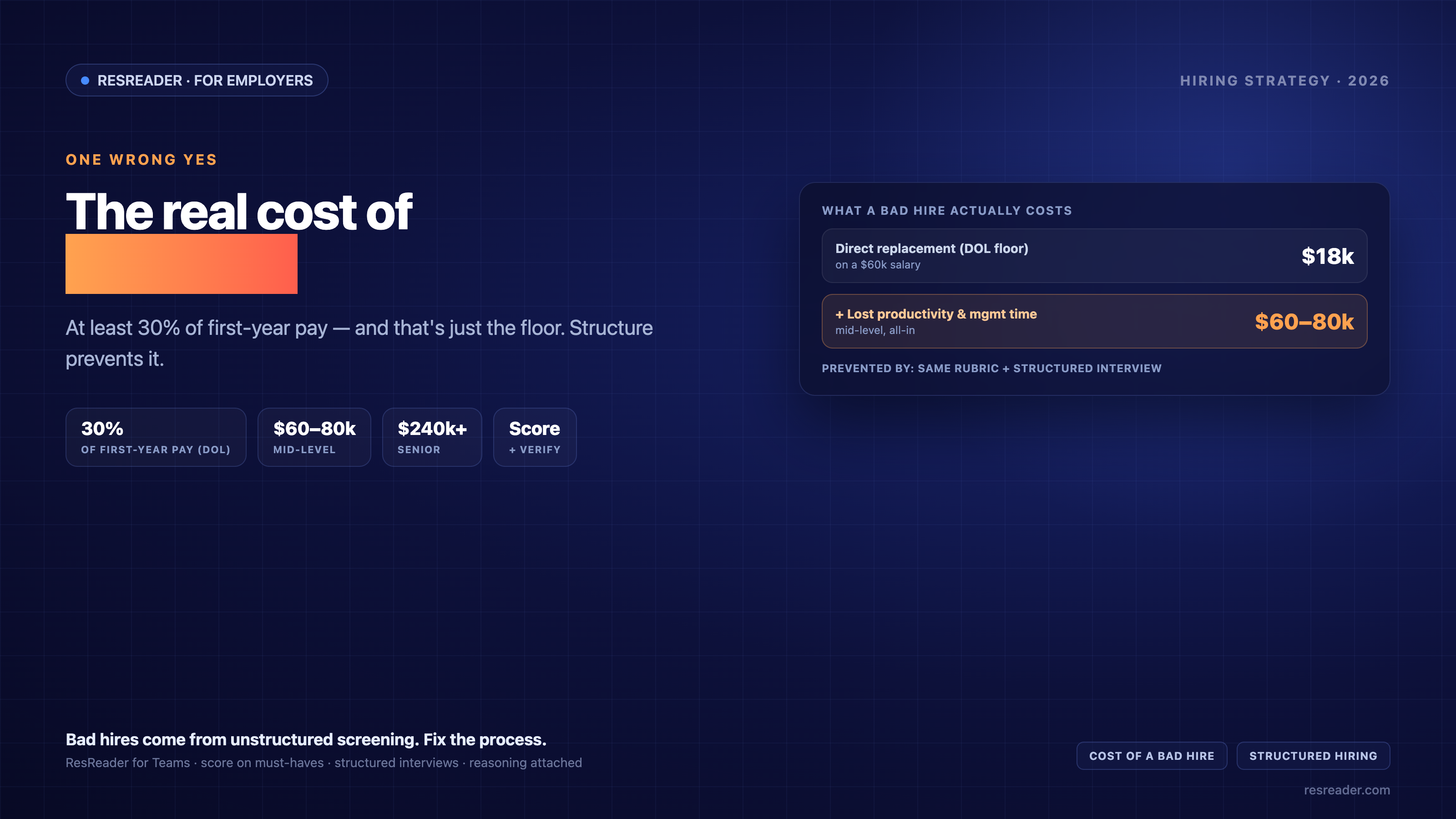
The most-cited number comes from the U.S. Department of Labor: a bad hire costs at least 30% of that employee's first-year earnings. On a $60,000 salary, that's $18,000 gone. And here's the part that matters: 30% is the floor — it only counts direct replacement costs. It doesn't include the productivity you lost, the manager hours spent coaching and cleaning up, the projects that slipped, or the hit to team morale. Factor those in and a typical mid-level bad hire runs $60,000–$80,000; a senior or specialized mis-hire can exceed $240,000 (industry estimates).
One wrong yes, and you've spent a full hire's salary to get nothing — then you get to pay to hire again.
Where bad hires actually come from
Bad hires aren't bad luck. They're almost always a screening failure, and usually one of these:
- Interviewing for polish, not ability. The person who's great at interviews isn't always great at the job. Charisma and a rehearsed story fool unstructured interviews constantly.
- Gut-feel and "culture fit." When there's no rubric, interviewers default to who reminds them of themselves — which filters for similarity, not capability, and misses strong candidates while advancing comfortable ones.
- Inconsistent evaluation. Five interviewers, five different mental yardsticks, no shared bar. The decision comes down to whoever argued hardest in the debrief, not the evidence.
- Keyword-matched resumes. Screening on keywords surfaces the best-written resume, not the best-matched experience — especially now that AI can perfect any resume in seconds.
Notice the theme: bad hires come from unstructured, inconsistent evaluation. Which is also the good news — because that's fixable.
The fix: structure beats instinct
Decades of research point to the same conclusion: structured, consistent evaluation predicts on-the-job performance far better than gut feel. Two changes do most of the work:
- Score every candidate against the same, role-specific rubric. Define what "qualified" means — the actual must-have skills and experience — before you screen, and hold every applicant to it. Consistency is what strips out the bias and vibe that produce mis-hires.
- Verify ability with a structured interview. Ask every candidate the same role-relevant questions against the same scoring, so you're comparing demonstrated skill — not who tells the smoothest story. A structured interview is one of the most predictive tools available for separating "interviews well" from "can do the job."
The goal isn't more interviews. It's a consistent signal you can trust — and reasoning attached to every decision, so you can see why someone passed, not just that they did.
How ResReader prevents mis-hires
ResReader is built to put structure into screening without slowing you down. You define the role's must-haves once, and AI scores and ranks every candidate against them — real experience, not keyword overlap — so polished-but-unqualified resumes don't float to the top.
Then structured AI interviews ask every candidate the same role-specific questions against the same rubric, with written reasoning attached to each score. You get a shortlist built on demonstrated ability and a clear paper trail behind every decision — the two things that turn "they interviewed well" into "they can actually do this." Preventing a single bad hire pays for the tooling many times over.
Frequently asked questions
How much does a bad hire cost?
The U.S. Department of Labor estimates at least 30% of the employee's first-year earnings — about $18,000 on a $60,000 salary. That's a conservative floor covering direct replacement only; with lost productivity and management time, a mid-level bad hire typically runs $60,000–$80,000, and senior mis-hires can exceed $240,000.
What causes most bad hires?
Unstructured, inconsistent screening: interviewing for charisma over ability, gut-feel "culture fit," different interviewers using different bars, and keyword-matched resumes that reward writing over real experience.
How do you prevent bad hires?
Score every candidate against the same role-specific rubric before screening, and verify ability with a structured interview that asks every candidate the same questions. Consistent, evidence-based evaluation predicts performance far better than gut feel.
The takeaway
A bad hire isn't a $0 mistake you shrug off — it's tens of thousands of dollars, plus the drag on your team and the cost of doing it all again. And it's rarely bad luck; it's an unstructured process rewarding the wrong signals. Define "qualified" up front, score every candidate the same way, and verify with a structured interview. Structure is boring — and it's exactly what stops you from paying twice for one hire.
Want to stop mis-hires before they cost you? See how ResReader scores and interviews candidates consistently.