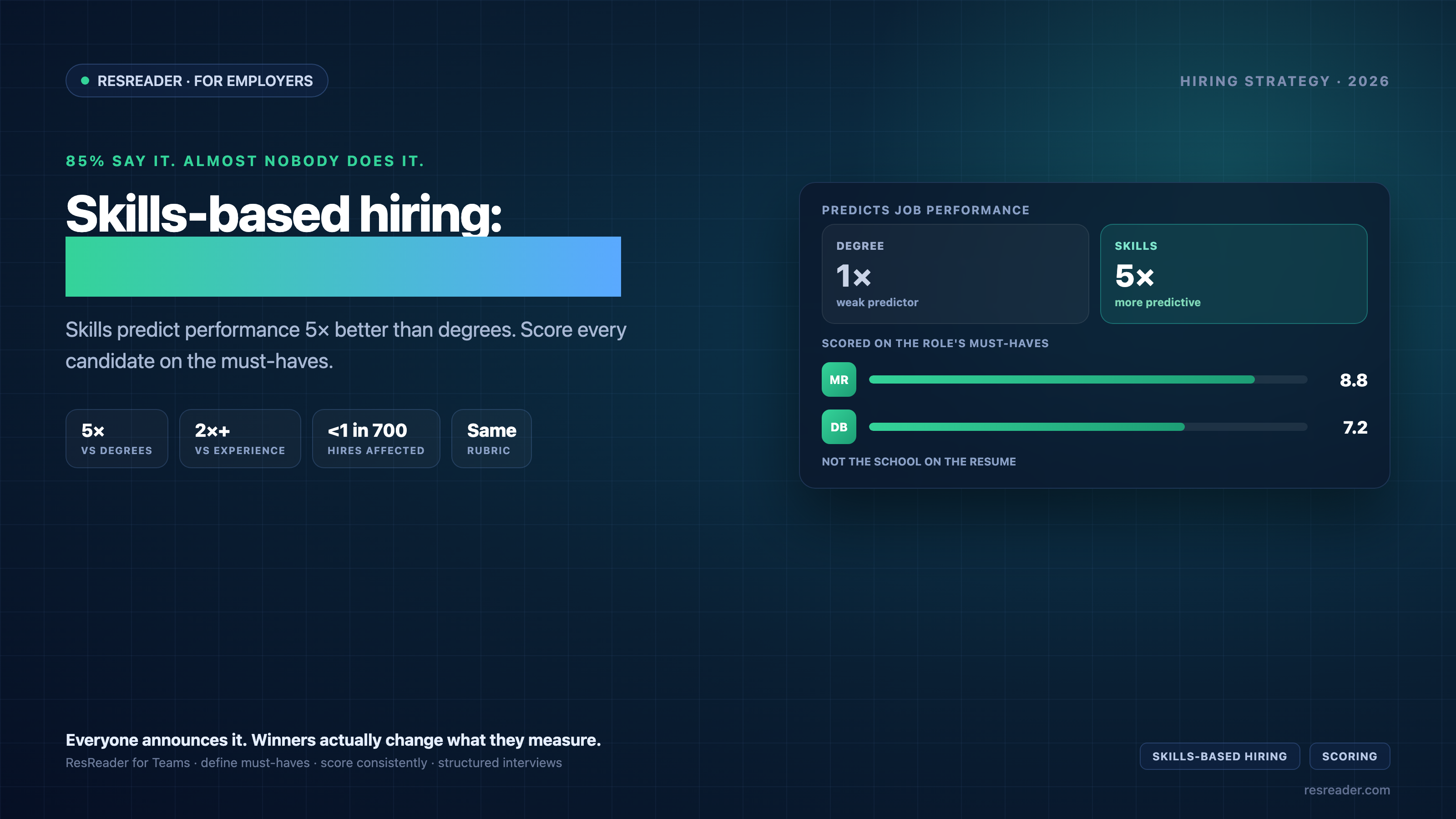
"Skills-based hiring" is the most agreed-upon idea in recruiting — and the least practiced. Around 85% of employers say they use it. Dropping degree requirements is now a press release template; Google, IBM, and Apple all did it. On paper, the degree era is over.
Then Harvard looked at the actual hires. The finding: fewer than 1 in 700 hires are genuinely affected by companies dropping degree requirements. Most of "skills-based hiring" is a line removed from a job posting and nothing else changed downstream. The intent is real. The practice mostly isn't.
That gap is a problem — because the underlying idea is one of the best-supported findings in hiring.
Why skills beat degrees (the data)
McKinsey's research is blunt: hiring for skills is about 5× more predictive of job performance than hiring for education, and more than 2× more predictive than hiring for years of experience. Read that again — the two things resumes lead with, the degree and the tenure, are the weakest predictors of whether someone can actually do the job. The skill itself is the strongest.
The upside when companies act on it is real too: a large share of organizations that genuinely adopt skills-based hiring report shorter time-to-hire, and dropping degree filters widens the qualified pool to capable people the old screen would have thrown out automatically.
So if the idea is this well-supported, why does almost no one actually do it?
Why the gap exists
Removing "bachelor's degree required" from a posting feels like skills-based hiring, but it changes nothing on its own. The rest of the machine still runs on proxies:
- Sourcing still leans on pedigree — the same schools, the same companies.
- Screening still ranks by keywords and titles, not demonstrated ability.
- Interviews are still unstructured, so "skills" get judged on gut feel and vibe.
- Managers still default to "who looks like past hires" when the rubric is vague.
You can't bolt skills-based hiring onto a process built around credentials. To screen for skills, you have to actually measure them — consistently, for every candidate.
How to actually screen for skills
Three concrete moves turn the slogan into practice:
1. Define the role's real must-haves — as skills, not credentials. Before you see a single resume, write down what the person must be able to do: the specific competencies, seniority, and domain the role requires. This becomes the yardstick every candidate is measured against — instead of a fuzzy sense of "qualified" that drifts with each reviewer.
2. Score every candidate on those must-haves, the same way. Rank resumes by how well the actual experience maps to the required skills, not by keyword match or school name. Consistent scoring against a fixed rubric is what removes the pedigree bias that quietly creeps back in.
3. Verify skills with a structured interview. Ask every candidate the same role-specific questions against the same rubric, so you're comparing demonstrated ability, not charisma or shared background. Structured interviews are one of the most predictive, least biased screens available — and they're where "skills-based" stops being a claim and becomes evidence.
How ResReader makes it practical
The reason skills-based hiring stays theoretical is that doing it by hand — a consistent rubric, applied to every candidate, at volume — is slow. That's the gap ResReader closes.
You define the role's must-have skills once, and AI scores and ranks every applicant against those — not keywords, not credentials — so the shortlist reflects demonstrated fit. Then you run structured AI interviews: the same questions and scoring for every candidate, with written reasoning attached to each score. The result is a hiring decision built on skills you can actually point to — the thing 85% of companies say they want and almost none operationalize.
Frequently asked questions
Is skills-based hiring actually better than hiring by degree?
The data says yes: McKinsey found skills are about 5× more predictive of job performance than education. Degrees and years of experience are among the weakest predictors of on-the-job success.
Why do so few companies actually do skills-based hiring?
Because removing a degree requirement from a posting doesn't change sourcing, screening, interviews, or manager incentives. Harvard found fewer than 1 in 700 hires are genuinely affected — the practice lags the intent unless you restructure how candidates are scored.
How do you screen for skills at scale?
Define the role's must-have skills up front, score every candidate against that fixed rubric (rather than keywords or pedigree), and verify with a structured interview. AI makes applying one consistent rubric to hundreds of candidates practical.
The takeaway
Skills-based hiring isn't a controversial idea — it's a proven one that almost nobody executes. The winners in 2026 won't be the companies that announce it; they'll be the ones that actually change what they measure: real must-have skills, scored consistently for every candidate, verified in a structured interview. Do that, and you're not just saying you hire for skills — you can prove it.
Want to score every candidate on the skills that matter, not the school on their resume? See how ResReader does it.