The Best ATS for Small Business in 2026 — What Lean Teams Actually Need
If you run a five-person business, a fifty-person team, or a small recruitment agency, you don't need an enterprise ATS with twelve modules and a six-week onboarding. You need a tool that solves the actual bottleneck — usually "we have 400 resumes on this job and nobody has time to read them all" — without making you spend a quarter learning it.
This post lays out what a small-business ATS in 2026 should genuinely be able to do, and walks through how we built ResReader around exactly those needs. We won't pretend ResReader is the right pick for every situation — we'll point out where it isn't — but if the bottleneck is volume and you want AI screening that actually reasons about candidates, this is the tool we'd recommend without hesitation.
What a small-business ATS actually needs to do in 2026
If you're hiring under 30 people a year, you don't need an HRIS integration roadmap. You need:
- A free or low entry tier you can use before committing budget.
- AI screening that genuinely reads resumes, not a keyword filter dressed up as AI.
- Public, self-serve pricing so you can evaluate without a sales call.
- A hosted careers page that Google for Jobs will index without setup.
- Sensible bulk operations — bulk email, bulk interview invites, bulk rejection — because small teams can't process candidates one at a time.
- Multi-language support if you hire outside one country (a real requirement in 2026, not a nice-to-have).
- Team workspaces so multiple recruiters and hiring managers can share a pipeline without paying per seat.
- A short setup: under an hour to your first scored candidate, ideally under fifteen minutes.
Most enterprise ATSes fail the first three. Most free tools fail the next four. ResReader was built to clear all eight.
How ResReader is built for the lean-team bottleneck
The rest of this post walks through what ResReader actually ships today, mapped to the list above.
Native AI resume scoring — with reasoning attached
When a resume lands in ResReader, the AI reads it against the job and returns:
- An overall rating from 0 to 10 — applied to the role's specific requirements, not a generic "good resume" score.
- Five sub-criteria scores: skills match, experience relevance, seniority fit, domain fit, keyword coverage %.
- A written 2–6 sentence assessment in the language of your choice — what you'd write yourself after reading the resume.
- A Qualified / Not Qualified classification based on mandatory skills you defined on the job.
This is the difference between AI screening that saves time and AI screening that doesn't: every score has reasoning attached. A candidate scoring a 6 isn't a mystery; you can see what the AI flagged as thin and what it flagged as strong.
Defining "qualified" once per job — mandatory skills are set when you create the job — means every applicant gets classified the same way. No calibration drift across recruiters. No "depends who's reviewing today."
Async AI video interviews, built in
For first-round screens, ResReader sends an interview invite link by email (single or bulk). The candidate records their answers in the browser on their own time. ResReader transcribes in real time and returns:
- Per-question scoring.
- A full transcript.
- Written feedback on each answer.
- An overall recommendation.
Two things make this work for small teams:
- Bulk invites. Select the qualified candidates from the analysis page; send the same interview invite to all of them in one action. Up to 5 custom questions per send.
- No calendar coordination. Candidates record when they want. You review when you have time. Zero recruiter hours spent on scheduling logistics.
The output is a structured scorecard you can sort and rank — turning fifty phone screens into a Friday morning of review.
AI Job Matching — surfacing past applicants for new roles
A small team's secret weapon is the resume bank they've already built. Most teams forget it exists.
When you publish a new job, ResReader runs a semantic vector search across your existing resume bank and surfaces the top 50 candidates from prior reqs who already match the new role. This isn't keyword matching — it's vector similarity, so a candidate whose CV mentions "RDBMS" gets matched against a role asking for "PostgreSQL experience."
The most common feedback we hear: "we hired someone we'd already screened six months ago without realizing."
Each candidate card also shows a reverse-match badge ("✨ N matches") when their resume scored well on other open roles — so when you look at one application, you immediately know if this person should be routed to two other roles too.
Compare candidates side-by-side
When you've narrowed a role to 2 or 3 finalists, the Compare action pulls their ratings, interview scores, qualified/not-qualified status, and top skills into a single AI-generated comparison. You can steer it with a custom prompt — "focus on system design depth," "weigh team leadership heavier," "compare on customer-facing communication."
The output reads like the memo you'd write for the hiring manager — except it's generated in seconds and saved to a comparison history dialog so you can revisit how a decision was reasoned later.
Bulk operations — without losing the personal touch
Volume work breaks small teams because the small actions compound. ResReader's bulk surfaces are designed to take each repetitive action from one click per candidate to one click per cohort:
- Bulk email with open tracking.
- AI-drafted rejection emails (bulk) — either let the AI personalize per candidate, or give it a single reason in plain English and have it rewrite professionally per candidate. Every draft lands in a preview queue you review before send.
- Bulk interview invitations — qualified candidates get the async AI video interview link in one batch.
- Twilio SMS — outbound and inbound, with status callbacks. For high-priority outreach where email isn't getting opened.
- Bulk follow-up questions — send the same structured follow-up set to a cohort of candidates whose first-round answers were close but ambiguous.
The pattern: any action you'd do per candidate, ResReader gives you a cohort-level version of. Recruiter judgement still happens at the preview step — but the typing, copy-paste, and individual sends are gone.
Hosted careers page + Google for Jobs (automatic)
Every workspace on ResReader gets a public careers page at resreader.com/[locale]/[businessId] and every job at resreader.com/[locale]/[businessId]/[jobId]. Both URLs render server-side and emit a JSON-LD JobPosting schema with all the fields Google for Jobs requires — including validThrough (auto-set 60 days forward), hiringOrganization, and directApply: true.
Practically: you publish a job, and within 24–72 hours it appears in Google's job widget when candidates search matching queries. No SEO consultant, no schema debugging, no sitemap configuration. The sitemap, the structured data, and the indexing are handled for you.
Team workspaces and calendar integration
ResReader is multi-user from day one. A workspace can have multiple team members — recruiters, hiring managers, anyone you invite. Pricing is metered on AI scans, not seats, so adding a hiring manager to the workspace costs you nothing.
For interview scheduling, recruiters connect their Calendly account via OAuth, and candidates book from real availability without you doing any calendar wrangling.
50+ languages, natively
If you hire across countries, the language situation gets complicated fast — you need to read the CV (which may be in the candidate's language), write your analysis (in your own working language), and message the candidate (back in their language). Most ATSes flatten this to "set one language and hope for the best."
ResReader splits it into three configurable fields per job:
analysisLanguage— the language ResReader writes assessments and reasoning in (usually your working language).candidateFacingLanguage— the language emails, invites, and rejections go out in (usually the candidate's language).aiInterviewLanguage— the language the AI video interviewer conducts the interview in.
Across 50+ supported languages, this means a Turkish-language CV can be analyzed in English (so the US-based recruiter reads it natively) and the rejection note sent back in Turkish (so the candidate experiences the message in their first language). At any volume across markets, this is the difference between a respectable employer brand in every country and being remembered as "the company that sent me a form letter in a language I don't speak."
Pricing — public, self-serve, no calls
Every tier price is on the page. No sales-gate. Cancel anytime.
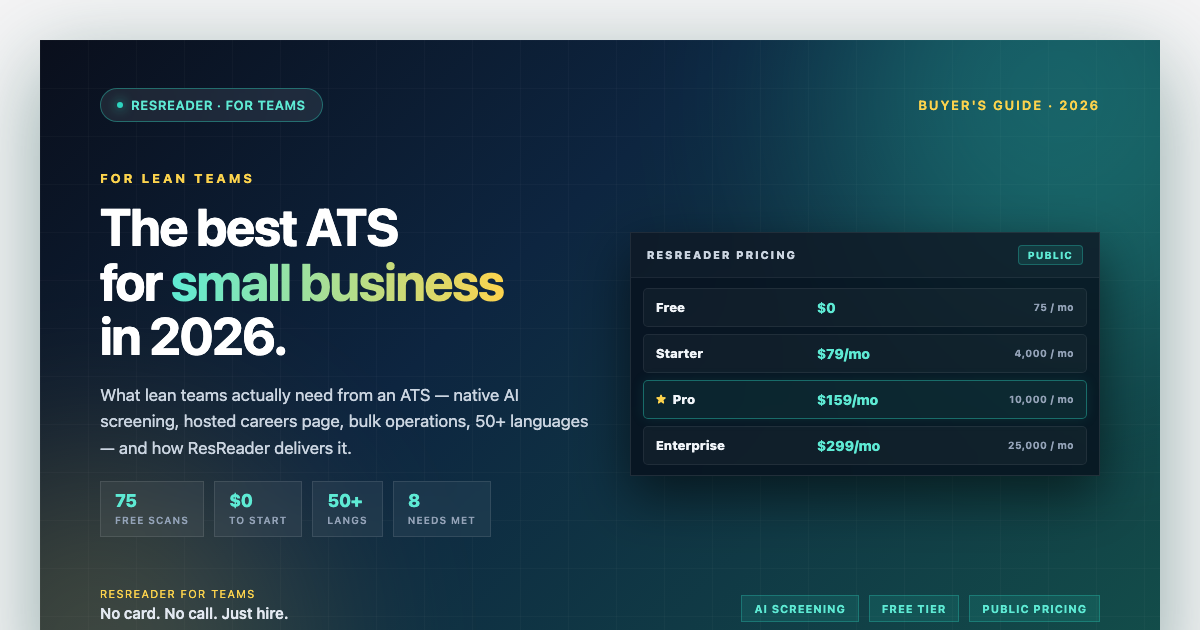
| Plan | Price | Scans/month | Storage | Support |
|---|---|---|---|---|
| Free | $0 | 75 | — | |
| Starter | $79/mo | 4,000 (~80K resumes storage*) | 20 GB | |
| Pro ⭐ | $159/mo | 10,000 (~200K resumes storage*) | 50 GB | Priority |
| Enterprise | $299/mo | 25,000 (~400K resumes storage*) | 100 GB | Dedicated success manager + custom AI models |
*Storage estimates based on ~250 KB per resume.
Extra scan packs (persistent — don't expire monthly):
- Starter: $20 per 1,000 scans
- Pro: $19 per 1,000 scans
- Enterprise: $18 per 1,000 scans
Pro is the most-popular tier — it's where most growing teams land. Free is meant for real evaluation, not a sales trap; 75 scans/month is enough to run a small role end-to-end and see whether the workflow actually saves you the hours we're claiming it does.
Honest limits — what ResReader isn't (yet)
We don't believe in marketing copy that doesn't list limits. A few things ResReader doesn't do today:
- No SAML / SSO. Email, Google, and Apple sign-in only. If your procurement requires SSO, ResReader isn't the right fit yet.
- No built-in EEO / OFCCP reporting. US enterprise compliance reporting isn't shipped.
- No public REST API. Internal Cloud Functions exist, but there's no documented public API for custom integrations.
If any of those are hard requirements for you, ResReader probably isn't the right call. For lean SMB teams whose actual bottleneck is volume + AI screening depth + multi-language, it almost certainly is.
A one-afternoon evaluation
You don't need a procurement cycle to pick an ATS for a small business. The fast version:
- Create a workspace. No card required.
- Publish one real job. Use the public application link or the careers page URL.
- Upload last quarter's resume folder for that same job. The easiest way to evaluate AI scoring is to compare its rankings to actual hire decisions you already made.
- Try the bulk operations. Bulk-reject the bottom of the funnel with the AI-drafted preview flow; bulk-send interview invites to the top. Feel the friction (or lack of it).
- Open your hosted careers page. Would you apply through it if you were a candidate?
That's a one-afternoon evaluation. By the end of it, you'll know whether ResReader saves the hours we're claiming. If it does, you stay on the free tier or move to Starter when 75 scans/month stops being enough. If it doesn't, you've spent an afternoon and zero dollars.
If you want to start that afternoon now, ResReader's free plan includes 75 AI scans per month — no credit card.
Looking for your next role? Open ResReader for Candidates →