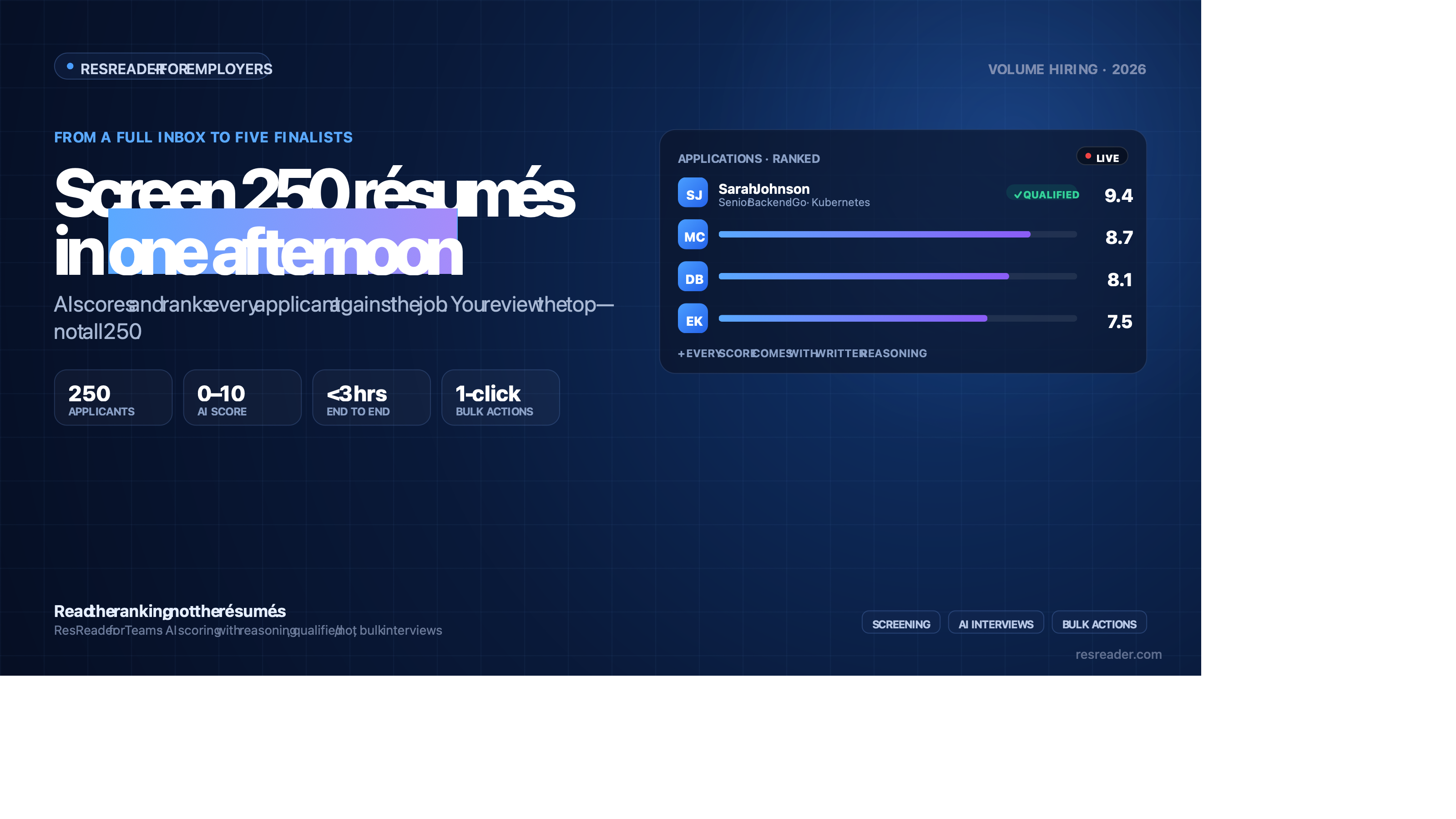
Quick answer: You can take a 250-applicant role from full inbox to five interview-ready finalists in about three hours by changing the order of operations: let AI score and rank every resume against the job first (minutes, not days), spend your human time only on the ranked top of the funnel, send first-round AI interviews to the qualified group in one batch, and bulk-close the clear nos with reviewed-before-send rejection emails. Below is the hour-by-hour version.
A senior role goes live. Forty-eight hours later there are 250 applications and zero free afternoons. The usual response is to read the first 40, skim the next 60, and quietly never open the rest — which means strong candidates on "page 4" never get seen. That's not a judgment problem; it's a throughput problem. Here's how to clear it in one sitting.
Before you start (5 minutes)
Two things determine whether the afternoon works:
- A specific job description. The AI scores against this. "Backend engineer, 5+ yrs, Go, payments domain, owns production services" produces sharp ranking; "rockstar developer" produces mush.
- A one-line screening prompt that captures what you actually weight: must-haves, nice-to-haves, and any red flags ("no production deployment experience" / "less than 1 year per role"). This is the difference between generic scoring and scoring the way you'd do it yourself.
2:00 — Upload the whole pile (10 minutes)
Don't pre-sort. Drag all 250 resumes into the job at once (ResReader takes PDF, DOC, DOCX, and scans, up to 10,000 per job). The pipeline runs in parallel: text extraction → language detection → duplicate check → AI analysis → scoring → skill normalization. Duplicates already in your bank reuse existing data, so you don't burn a scan twice.
Results start appearing as they finish — you don't wait for all 250 before you begin.
2:15 — Read the ranking, not the resumes (45 minutes)
Now the inversion. Instead of reading 250 resumes, you read the AI's ranked output and spot-check it. For each candidate ResReader returns:
- An overall score (0–10) against the role's actual requirements
- Sub-scores: skills match, experience relevance, seniority fit, domain fit, keyword coverage
- A written 2–6 sentence assessment explaining the score
- A Qualified / Not Qualified flag based on the must-haves you defined
Sort by score. Read the top ~30 assessments closely and open the resumes behind any that look borderline or surprising. You're not re-screening the whole pile — you're auditing the model's reasoning on the part of the funnel that matters. Because every score has reasoning attached, a "6" isn't a mystery: you can see what was thin and what was strong, and override it when you disagree. Human judgment stays in the loop; the reading-fatigue tax is gone.
Filter by skill or by qualified/pending to slice the list further when you need to.
3:00 — Send first-round interviews in one batch (10 minutes)
Select your qualified shortlist (say, the top 15–20) and send the async AI video interview to all of them in a single action — up to 5 custom questions per send. Candidates record on their own time; there's no calendar coordination. As responses come back you get a transcript, per-question scores, and a recruiter-ready scorecard for each — turning what used to be 15 scheduled phone screens into a review queue.
This step is what actually compresses time-to-hire: the longest queue in most pipelines is waiting for screen-call slots, and you just deleted it.
3:10 — Close the clear nos, kindly (15 minutes)
The bottom of the funnel deserves a real reply, not silence. Bulk-select the clearly-unqualified group and generate rejection emails: either let the AI personalize per candidate, or give it one plain-English reason and have it write professionally for each. Every draft lands in a preview queue you approve before anything sends — bulk speed, human check.
Treating rejected candidates well is also brand insurance; "page 4" still talks.
3:25 — Handle the maybes (15 minutes)
For borderline candidates whose answers were close but ambiguous, send a batch of follow-up questions rather than rejecting or advancing blindly. You get a little more signal for very little time.
3:40 — Compare the finalists (20 minutes)
When you're down to 2–3, use the side-by-side comparison: it pulls ratings, interview scores, qualified status, and top skills into one AI-generated memo you can steer with a prompt ("weigh system-design depth heavier"). It reads like the write-up you'd hand a hiring manager — generated in seconds and saved so you can revisit how the decision was reasoned.
Where the afternoon went
| Time | Step | Output |
|---|---|---|
| 2:00 | Upload 250 | Pipeline running |
| 2:15 | Read the ranking | Top ~30 audited |
| 3:00 | Bulk interview invites | 15–20 async interviews out |
| 3:10 | Bulk rejections (reviewed) | Funnel bottom closed kindly |
| 3:25 | Follow-ups to maybes | Extra signal gathered |
| 3:40 | Compare finalists | 2–3 ready for the hiring manager |
From a 250-deep inbox to a defensible shortlist in one afternoon — without pretending you read all 250 by hand.
Honest limits
- AI ranking is only as good as the job description and prompt you give it. Garbage in, mushy ranking out — spend the five minutes upfront.
- The AI proposes; you decide. Audit the top of the funnel and override scores you disagree with. This is a tool to remove reading fatigue, not to hand hiring decisions to a model.
- Knockout/qualification flags depend on the must-haves you set per job. Set them deliberately.
Try it
ResReader's free plan includes 75 AI scans and 3 AI interviews per month — enough to run one real role through this playbook end to end. No credit card required. Start free.
FAQ
How long does it take to screen 250 resumes with AI? The AI scoring itself runs in minutes (in parallel). The human part — auditing the ranked top of the funnel, sending interviews, and closing the rest — fits in roughly an afternoon, versus the 1–2 weeks manual review usually takes.
Does AI screening just match keywords? No. Each resume gets a 0–10 score with sub-scores and a written rationale assessing contextual fit to the role, not keyword frequency — and you can read the reasoning behind every score.
Can I send first-round interviews to many candidates at once? Yes. Select your qualified shortlist and send the async AI video interview to all of them in one batch, with up to 5 custom questions. Candidates record on their own time; you review transcripts and scorecards.
What happens to the candidates I reject? You bulk-generate rejection emails (AI-personalized or from one reason you give), and every draft goes through a preview queue you approve before sending — so the funnel bottom gets a real, professional reply.
Is there a free way to try this? Yes — the free plan includes 75 scans and 3 AI interviews per month, enough to run a small role through the whole playbook.