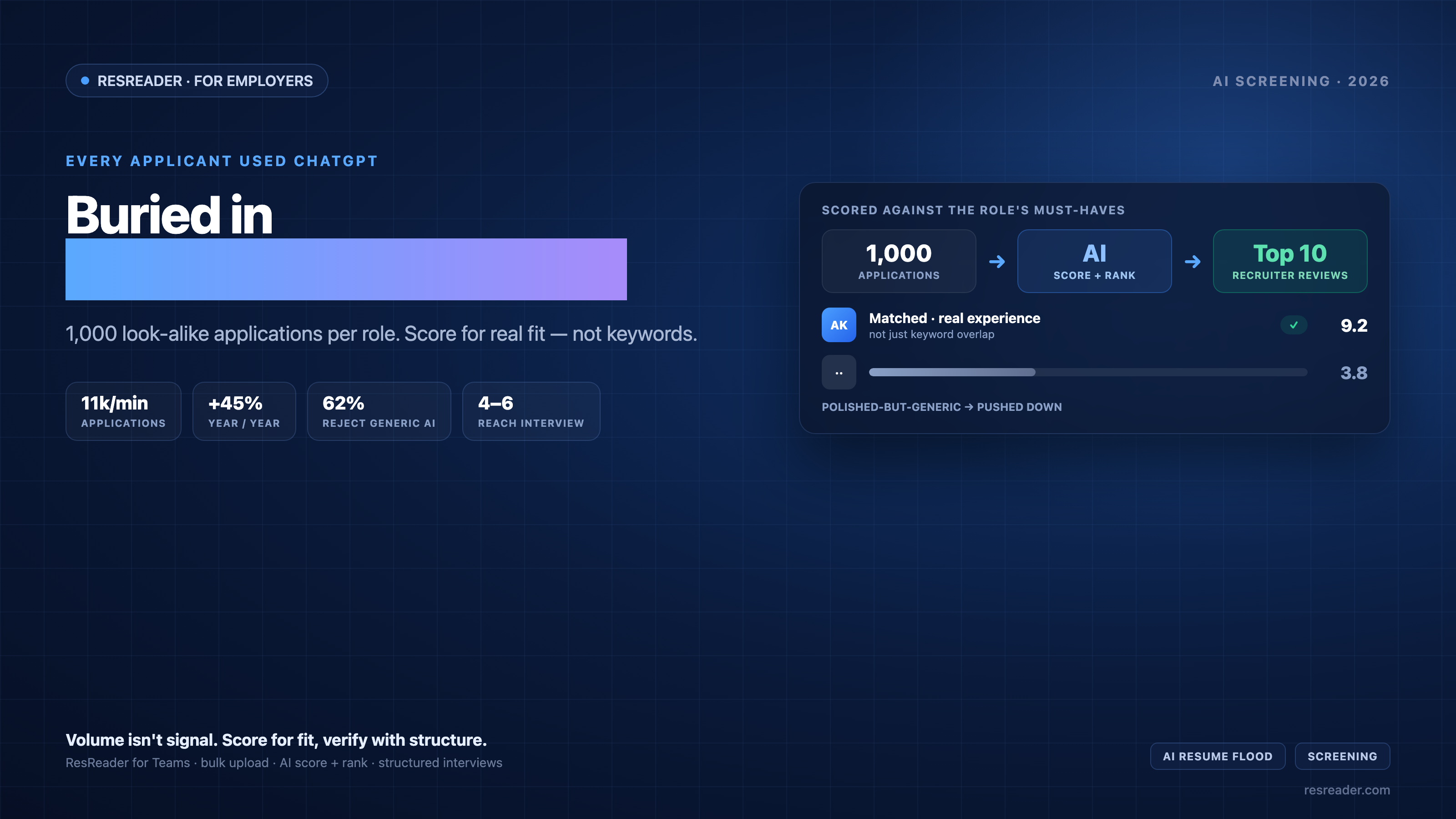
Post a role today and you're not reviewing applications — you're surviving a flood. LinkedIn is now processing around 11,000 applications every minute, and the number of applications submitted has jumped roughly 45% year over year. For competitive roles in tech, marketing, and remote work, hitting 1,000+ applicants in days has become normal.
And here's the twist that makes it worse: most of those resumes are excellent. Or at least they look excellent. AI has made it trivial for any candidate to generate a polished, keyword-perfect, "tailored" resume in thirty seconds. The old signal — this person took the time to write a strong application — is gone. Everyone clears that bar now.
So how do you find the real fit in a stack where every resume reads like the ideal candidate? Not by reading faster.
Why more applications didn't help anyone
You'd think a bigger pool means better hires. In practice, it's the opposite. Despite the volume explosion, only 4–6 candidates typically make it to the interview stage — the same as before. The flood didn't widen the funnel; it just buried the good candidates deeper in it.
Worse, AI adoption in HR climbed sharply — yet cost-per-hire and time-to-hire have both risen over the same years AI went mainstream. Around 90% of HR managers say their workload has increased because of the surge in AI-generated applications. The tools meant to save time created a new, bigger problem: separating genuine fit from AI polish, by hand, at 1,000 resumes per role.
The instinct that backfires: keyword matching
When volume spikes, the tempting fix is to filter harder on keywords. But that's exactly the game AI resumes are built to win. A model can mirror every phrase in your job description perfectly — which means keyword filtering now surfaces the best prompters, not the best candidates. You end up rejecting a strong applicant who described their work in their own words and advancing a weaker one who let ChatGPT echo your posting back to you.
Keyword matching was a weak proxy even before AI. Now it's actively misleading.
What actually works: score for fit, then verify
The way through the flood isn't reading faster — it's changing what you measure and when. Two moves matter:
1. Score every resume against the role's real must-haves, not its keywords. Instead of "does this resume contain the right words," the question becomes "does the experience here actually match what the role requires — the seniority, the domain, the specific responsibilities?" That's a judgment AI can help you make consistently across 1,000 resumes in minutes — surfacing the genuine matches and pushing the generic-but-polished ones down, where they belong.
2. Verify with a structured interview early. A resume — AI-assisted or not — is a claim. The fastest way to test it is a short, structured interview where every candidate answers the same role-specific questions against the same rubric. AI polish can't fake a spoken answer about a real project. Moving a lightweight structured screen earlier in the process is how you tell the real experience from the well-written summary.
Note what employers are actually reacting to: in a survey of 925 HR professionals, 62% said AI-generated resumes without personalization are more likely to be rejected, and 78% said personalized, specific details signal genuine interest and fit. Employers aren't anti-AI — they're anti-generic. Your screening should reward the same thing: real, specific, verifiable fit.
How ResReader handles the flood
This is the exact problem ResReader was built for. You upload every resume at once — hundreds in one go — and the AI scores and ranks each one against the role's actual must-haves, not just keyword overlap. Your recruiter reviews the top candidates instead of the whole pile, spending hours instead of days on the part machines do better.
Then, to separate real experience from AI-polished summaries, you can run structured AI interviews — the same questions and rubric for every candidate — so the shortlist is built on how people actually answer, not just how well their resume was written. It's screening designed for a world where a great-looking resume no longer means what it used to.
Frequently asked questions
Can you detect an AI-generated resume?
Increasingly, generic AI resumes stand out because they mirror the job posting without specific, verifiable detail. But detection isn't the goal — fit is. Score candidates on whether their actual experience matches the role, and verify with a structured interview, rather than trying to police how the resume was written.
How do you screen hundreds of applications quickly?
Upload them in bulk and let AI score and rank each one against the role's must-haves, then have a recruiter review only the top candidates. Manual, one-by-one review doesn't scale past a few dozen applications, let alone a thousand.
Should candidates be penalized for using AI on their resume?
Not for using AI — for being generic. Surveys show employers reject AI resumes that lack personalization, while rewarding specific, tailored detail. Screen for real fit, not for the tool the candidate used.
The takeaway
The resume flood isn't going away — AI made applying effortless, so volume will only climb. But volume was never the goal; fit is. Stop trying to read faster or filter harder on keywords, both of which now favor the best prompt, not the best hire. Score every candidate against the role's real requirements, verify the shortlist with a structured interview, and reward specific, genuine fit over generic polish. That's how you find the right person in a stack of a thousand.
Screening more resumes than your team can read? See how ResReader scores and ranks them in minutes.