Quick answer: Agencies don't have a hiring problem — they have a throughput across many clients problem. The setup that works in 2026: a separate workspace per client (so data and branding stay clean), AI résumé scoring against each client's specific job, first-round AI interviews so you send clients a shortlist instead of a stack, and per-recruiter tracking so you can see who's producing. ResReader does this in one tool, metered on scans rather than seats — so adding a recruiter doesn't add cost.
A staffing or recruitment agency runs a different game than an in-house team. You're not filling one role at a time — you're filling many roles for many clients, often with a lean bench of recruiters, and you're judged on speed and quality of shortlist. The bottleneck isn't any single pile of résumés; it's that there are ten piles at once and the context-switching is brutal.
What agencies actually need from a screening tool
- Clean separation per client. Client A's candidates, branding, and job criteria shouldn't bleed into Client B's. You need distinct workspaces, not one giant shared bucket.
- Fast, consistent screening per role. Each client's "qualified" is different. Screening has to be scored against that client's job, not a generic standard.
- A shortlist to hand over, not a stack. Clients pay you to do the filtering. Sending them 80 résumés is the thing you're supposed to prevent.
- Per-recruiter visibility. With multiple recruiters, you need to see who's sourcing, screening, and converting — without building a spreadsheet by hand.
- Pricing that doesn't punish your team size. Per-seat pricing taxes you for having recruiters. Usage-based pricing scales with actual work.
How to run it in ResReader
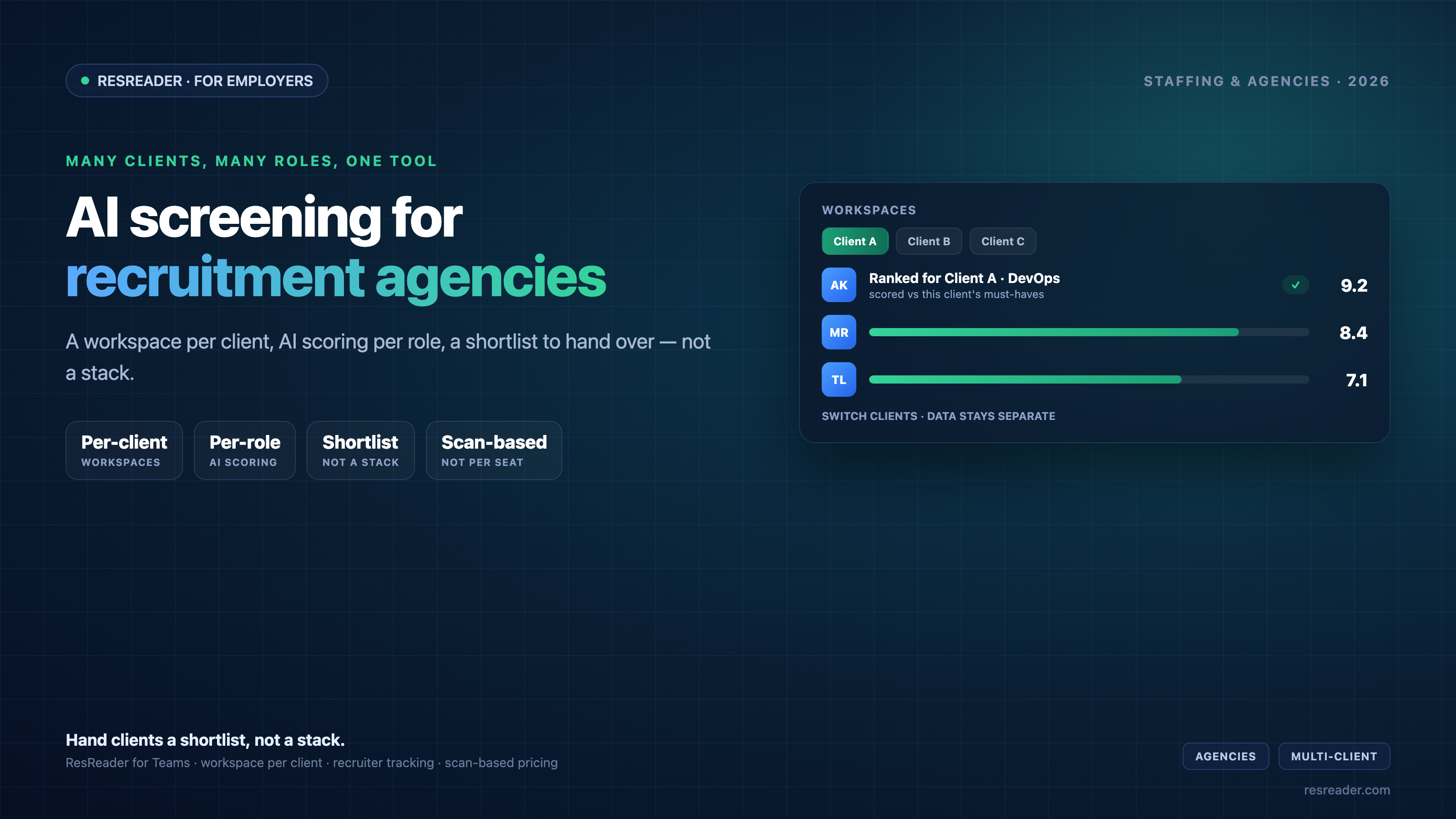
A separate workspace per client. Spin up a distinct workspace for each client and switch between them from the workspace switcher. Each one keeps its own jobs, candidate bank, branding, and team — so nothing cross-contaminates and you can hand a client a clean view of their own pipeline.
AI scoring against each client's job. Within a client's workspace, every résumé is scored 0–10 against that specific role, with sub-scores and a written rationale, plus a Qualified / Not Qualified call on the must-haves you set for that client. The 250-résumé pile becomes a ranked shortlist in minutes — per client, in their language if needed (50+ supported).
First-round AI interviews before the client ever sees anyone. Send the async AI video interview to your qualified shortlist in one batch. You hand the client transcripts, per-question scores, and a recommendation — a screened shortlist, not a stack. That's the value an agency is actually selling.
Per-recruiter tracking and shareable links. See how each recruiter is performing across roles, and use tracked share links so candidate sourcing is attributable. When you present candidates to a client, you're working from data, not memory.
Pricing that scales with work, not headcount. ResReader meters on AI scans, not seats — so adding a recruiter or a hiring contact to a workspace costs nothing. You pay for screening volume, which is the thing that actually grows with your business.
A practical multi-client rhythm
- One workspace per active client. Set each client's must-haves and job descriptions once.
- Batch-upload each role's applicants into the right workspace; let AI rank while you work the next client.
- Bulk-interview the qualified in each pipeline so shortlists build themselves overnight.
- Hand clients a scored shortlist with transcripts and reasoning — not a forwarded inbox.
- Check recruiter performance weekly to see where to rebalance the bench.
Honest limits
- ResReader is a screening and interviewing platform, not a full front-/back-office staffing suite — there's no built-in timesheet, payroll, or placement-billing module. Pair it with your CRM/billing system for those.
- No public REST API today, so deep custom integrations into an existing agency stack aren't available yet.
- It handles the screening and first-round throughput exceptionally well; the client relationship and commercial side still live in your CRM.
Try it
Run one client's hardest open role through a dedicated workspace: upload the applicants, let AI rank and interview them, and hand over a shortlist instead of a stack. Free plan includes 75 AI scans and 3 AI interviews per month, no credit card. Start free.
FAQ
Can I keep different clients' candidates separate? Yes. Use a separate workspace per client — each keeps its own jobs, candidate bank, branding, and team, and you switch between them from the workspace switcher.
Does each client get screening tuned to their role? Yes. Within a client's workspace, résumés are scored against that client's specific job and must-haves, with reasoning and a qualified/not-qualified call — not a generic standard.
Can I track how individual recruiters are performing? Yes. ResReader surfaces per-recruiter performance across roles, and tracked share links make sourcing attributable.
Does pricing charge per recruiter (seat)? No. It's metered on AI scans, not seats — adding recruiters or client contacts to a workspace costs nothing.
Is ResReader a full staffing back-office system? No. It's AI screening and first-round interviewing. It doesn't include timesheets, payroll, or placement billing — pair it with your CRM for the commercial side.