Quick answer: You freeze in interviews not because you don't know the answer, but because the live, evaluated, real-time version of recalling it is a separate skill you haven't rehearsed. The fix isn't more reading or more confidence affirmations — it's repetition under realistic conditions: practicing out loud, on camera, against real questions, enough times that the pressure stops being novel. You can do that today with AI mock interviews, before the interview that counts.
You know your work. You can explain that project to a friend over coffee without a single "um." Then the interviewer asks "walk me through a hard decision you made," and your mind — fluent thirty seconds ago — goes completely white. You stumble, over-explain, forget the obvious example, and replay it for three days afterward.
That's not a competence problem. It's a very specific, very fixable performance problem.
Why your brain goes blank
Three things stack up in a live interview that don't exist when you're just thinking about your experience:
- Evaluation pressure. The moment answers are being judged, your nervous system treats it as a threat. Working memory — the exact thing you need to retrieve an example and structure it — is the first casualty of that stress response.
- Real-time retrieval. Knowing something and producing it cleanly, out loud, in one take, under a clock, is a different task than knowing it. You've practiced the first; most people never practice the second.
- Novelty. The first few minutes of any high-stakes conversation are when you're most likely to choke, simply because the situation feels new. Brains calm down once a situation is familiar.
Notice what all three have in common: none of them are fixed by knowing more. They're fixed by having done it before.
Why the usual advice doesn't work
- "Just be confident." Confidence is an output of preparation, not an input you can will into existence. Telling an anxious person to be confident is like telling a cold person to be warm.
- "Re-read your resume and the job description." Useful, but it trains recognition, not retrieval. You'll recognize the topic; you still won't have rehearsed saying the answer.
- "Do a practice round with a friend." Closer — but friends are gentle, don't follow up on vague answers, and you can only ask so many times before it's awkward. The conditions aren't realistic and the reps don't scale.
What actually reduces the freeze: realistic reps
The freeze fades when the situation stops being novel, and the only way there is repetition under conditions close to the real thing. "Close to the real thing" means four things:
- Out loud, not in your head. Rehearsing answers silently builds the wrong muscle. You have to hear yourself form the sentence in real time.
- On camera. A video screen has a specific discomfort — being watched while you think. Practicing on camera makes that discomfort ordinary.
- Against real questions, with follow-ups. A static question list lets you prepare a monologue. A real interview interrupts: "can you give a specific example?" You need reps with that interruption.
- Repeated. Once is a baseline. The freeze melts somewhere around reps three, four, five — when your body stops treating the situation as an emergency.
The problem has always been access: you can't run five realistic, follow-up-driven, on-camera interviews with a human coach for free, the night before your interview. Now you can run them with AI.
How to use AI mock interviews to kill the freeze
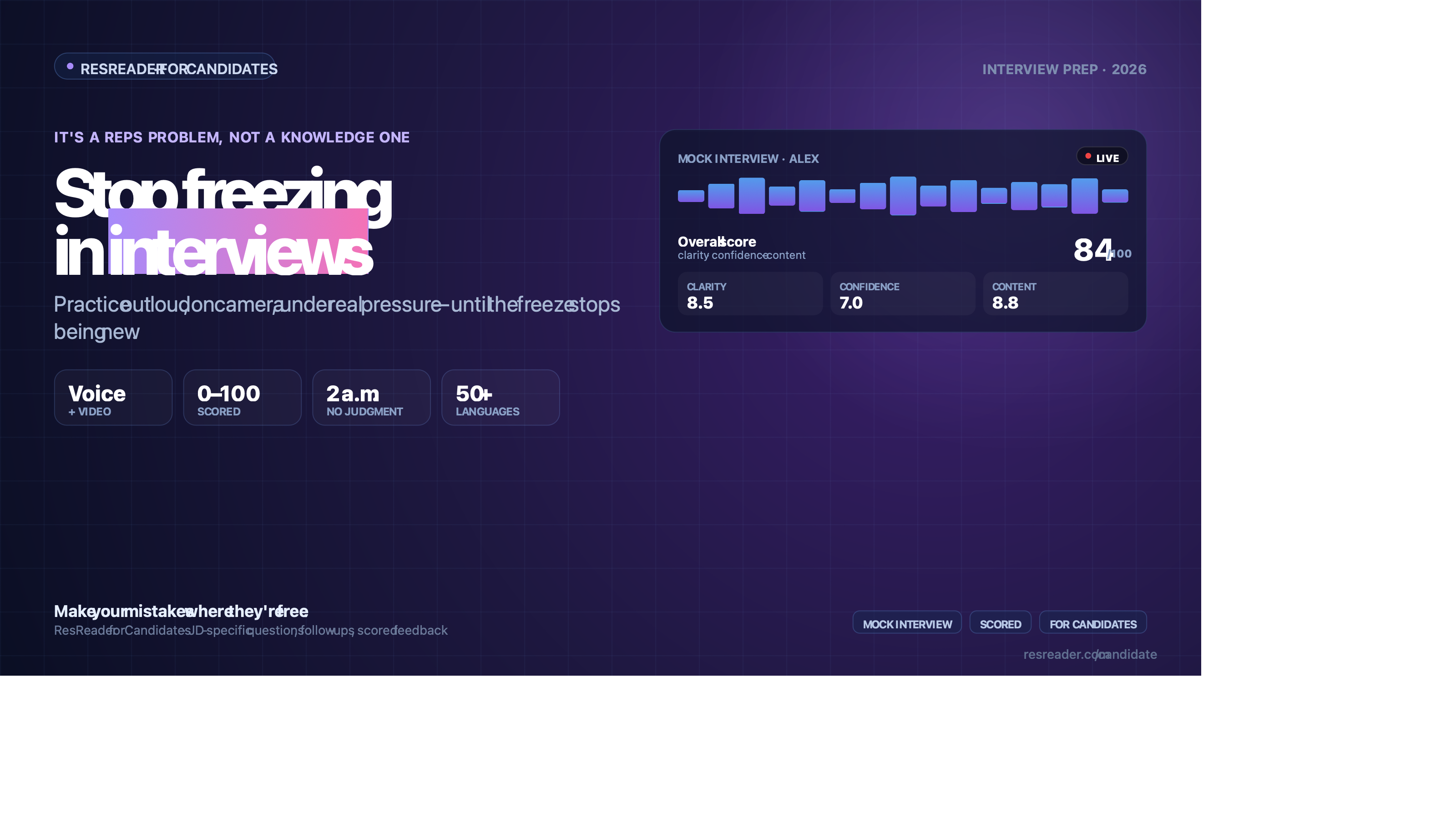
ResReader's mock interview is built for exactly these reps. You paste the job description, optionally attach your CV, and have a real voice-and-video conversation with an AI interviewer named Alex — who asks role-specific questions, follows up when your answer is vague, and scores you afterward on clarity, confidence, and content with specific, written feedback.
A practice plan that works:
- Two days out — baseline run. Do one full session. Expect a lower score than you'd like; that's the point. Read the "areas to improve" list carefully.
- One day out — second run. Same role, fresh questions (it avoids repeating what it already asked). Watch the score move. This is where the freeze starts dissolving.
- Optional third rep on your weak spot. If the feedback flagged one type of question, drill it again.
- The morning of — don't practice. Reps two days out build calm; a session twenty minutes before just spikes nerves. Close the laptop.
Because it's voice and video, you're rehearsing the exact discomfort you'll feel in the room — being watched, thinking on your feet, answering a follow-up you didn't see coming. By the real interview, the situation isn't novel anymore. That's the whole game.
Practice without anyone watching
The quiet advantage: you can run a mock interview at 2 a.m. in your kitchen, fail an answer completely, and no one ever knows. The AI doesn't judge, doesn't sigh, doesn't tell your network. Making your mistakes where they're free is what lets you stop making them where they're expensive.
Honest note
Mock interviews reduce the freeze; they don't erase nerves entirely, and they're not a substitute for actually knowing your field. If interview anxiety is severe enough to affect your daily life, that's worth talking to a professional about — this is about the ordinary performance nerves almost everyone has, and the reps that quiet them.
Try it
Run your first mock interview free — 5 per month, no credit card. Paste the job you're prepping for and let Alex put you under gentle pressure before the real thing does. Start free.
FAQ
Why do I freeze in interviews even when I know the answer? Because recalling something calmly and producing it out loud under evaluation, in real time, is a separate skill from knowing it. Stress hits working memory first. Rehearsing the live version is what fixes it.
How do I stop going blank under pressure? Repetition under realistic conditions — out loud, on camera, against real questions with follow-ups, several times — until the situation stops feeling novel. Reading and affirmations don't build that; reps do.
Do mock interviews actually help with anxiety? Yes, by removing novelty. The freeze is worst when a situation feels new; once you've done several realistic run-throughs, your nervous system stops treating the real interview as an emergency.
How many practice sessions do I need? A useful pattern is a baseline run two days out, a second run the next day, and an optional third on your weakest question type. Most people feel the freeze ease by the third rep.
Is there a free way to practice interviews with AI? Yes — ResReader's free plan includes 5 mock interviews per month (voice + video, scored feedback), no credit card required.