It usually comes near the end of the interview, and it sounds like an invitation to brag: "So, why should we hire you?" Most people react in one of two ways — they get uncomfortable and undersell ("Well, I think I'd be good at it…"), or they overcorrect and reel off a list of adjectives ("I'm hardworking, passionate, a fast learner…"). Both miss what the question is really doing.
Here's the reframe that fixes it: this question isn't about you. It's about their problem.
What the interviewer is actually asking
Companies don't hire people because they're impressive in the abstract. They hire because they have a problem — a gap, a workload, a goal — and they need someone to solve it. So "Why should we hire you?" really means: of everyone we could pick, why are you the best solution to what we need?
That's why leading with your hopes ("I'm looking for growth," "I want to develop my skills") falls flat. The strongest answers lead with their needs. You're not making a case for what the job does for you — you're making a case for what you do for them.
The formula
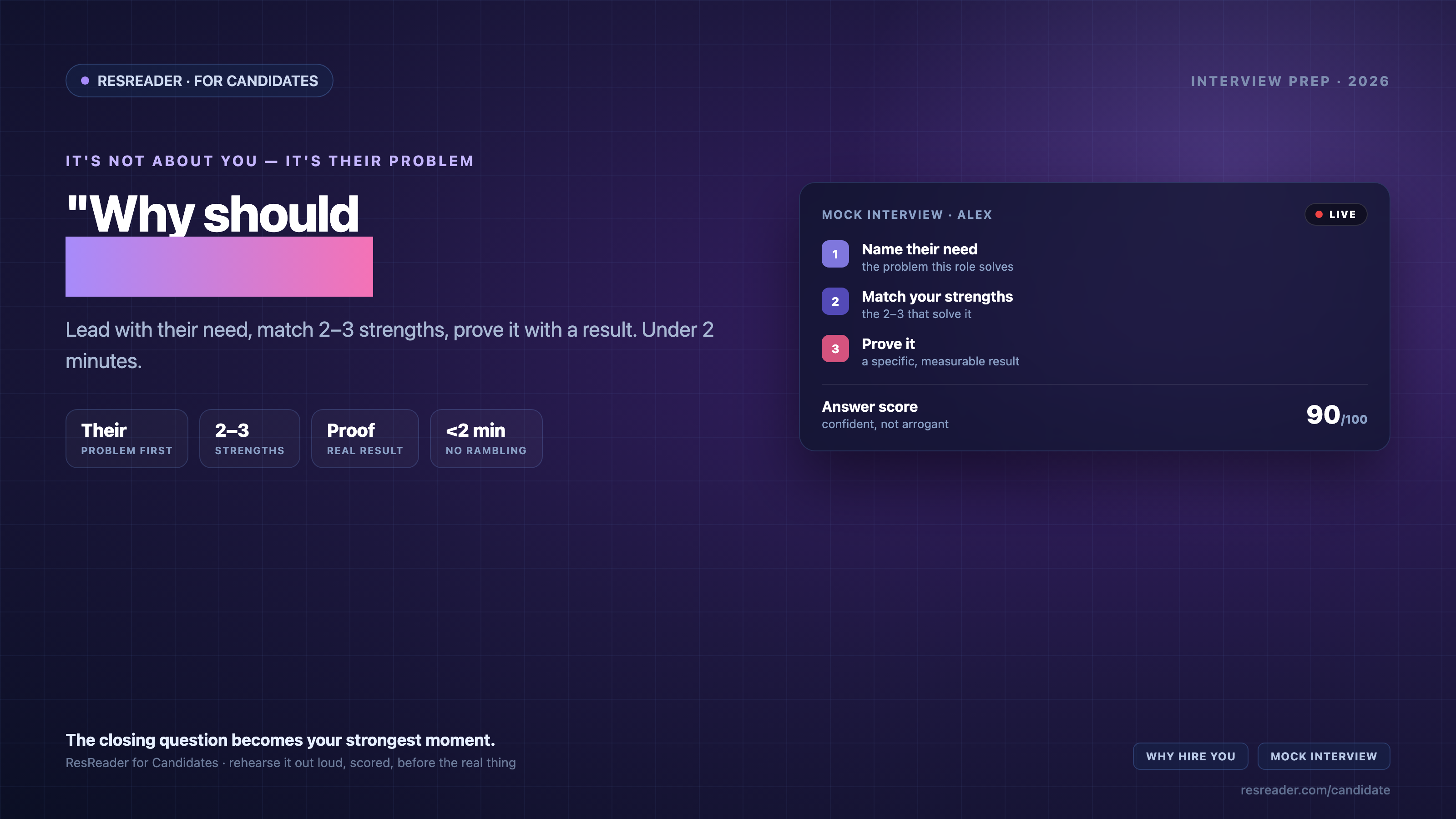
A great answer has three moves and takes about 90 seconds to two minutes:
- Name their core need. Show you understand the main problem this role exists to solve — the thing in the job description they care most about.
- Match your top two or three strengths to it. Not a laundry list — the two or three skills, achievements, or traits that most directly solve that problem.
- Prove it with a specific result. Interviewers remember stories, not adjectives. Back each claim with a concrete, ideally measurable, example of you having done exactly this before.
Then close by connecting it forward: this is why I'd hit the ground running here.
An example that lands
Weak version:
"You should hire me because I'm a hard worker, I'm passionate about this industry, and I'm a really fast learner who gets along with everyone."
That's all adjectives, all about the candidate, zero proof.
Strong version:
"From the job description, it sounds like the main challenge is that support tickets are piling up faster than the team can clear them. That's exactly the situation I walked into at my last company — I built a triage system and a set of canned responses that cut our average resolution time from two days to four hours, without adding headcount. I'd bring that same playbook here: find the bottleneck, fix the process, and get the queue under control fast. That's why I think I'm a strong fit for what you need right now."
It names their problem, matches a specific strength, proves it with a number, and points forward.
The mistakes that sink this answer
- Being arrogant. Confidence sells; arrogance worries. If you sound boastful, interviewers start wondering what you'd be like on a team. Let the results carry the confidence.
- Talking too long. Two minutes, max. A rambling answer buries your best point.
- Mentioning money. Even if pay is your real motivation, this isn't the moment. "You should hire me because I need the salary" answers a different question than the one they asked.
- Listing generic traits. "Hardworking, dedicated, team player" describes everyone and proves nothing. Specifics win.
- Reciting a memorized script. Word-for-word memorization comes out robotic. Know your structure and your stories; don't script every sentence.
Rehearse it out loud — this is the one you can't wing
"Why should we hire you?" rewards preparation more than almost any other question, because a strong answer weaves together their problem, your proof, and a confident-not-arrogant tone — live, in under two minutes. That's hard to do the first time, and the first time should not be the real interview.
This is what ResReader's AI mock interviews are for. You paste the actual job you're targeting, and the AI interviewer (Alex) asks you real questions out loud — including this one — then follows up, exactly like a real interviewer would. The moment you finish, you get a 0–100 score, your strengths, and specifically what to tighten. Run "Why should we hire you?" a few times until it comes out confident, specific, and tight.
The free plan includes 5 mock interviews a month, in 50+ languages — so you can rehearse in the language you'll actually be interviewed in.
Frequently asked questions
How do you answer "Why should we hire you?"
Lead with the employer's main problem, match your top two or three strengths to it, and prove each with a specific, measurable result — then connect it forward to how you'd contribute. Keep it under two minutes.
What should you not say when asked why they should hire you?
Don't list generic adjectives, don't mention needing the money, don't sound arrogant, and don't recite a memorized script. Avoid making the answer about what the job does for you instead of what you do for them.
How long should the answer be?
About 90 seconds to two minutes — long enough for one strong, specific example, short enough to keep the interviewer's attention.
The takeaway
"Why should we hire you?" isn't a bragging contest and it isn't a trap — it's your clearest chance to connect what they need with what you've proven you can do. Name their problem, match two or three real strengths, back them with a specific result, and keep it tight and confident. Rehearse it out loud until it sounds like you, not a script, and the closing question of the interview becomes your strongest moment in it.
Want to practice your answer — and the follow-up — out loud? Try a free AI mock interview on ResReader.