If you're firing the same resume at every job posting and hearing nothing back, the problem probably isn't your experience. It's that your resume was written for "jobs in general" — and no such job exists.
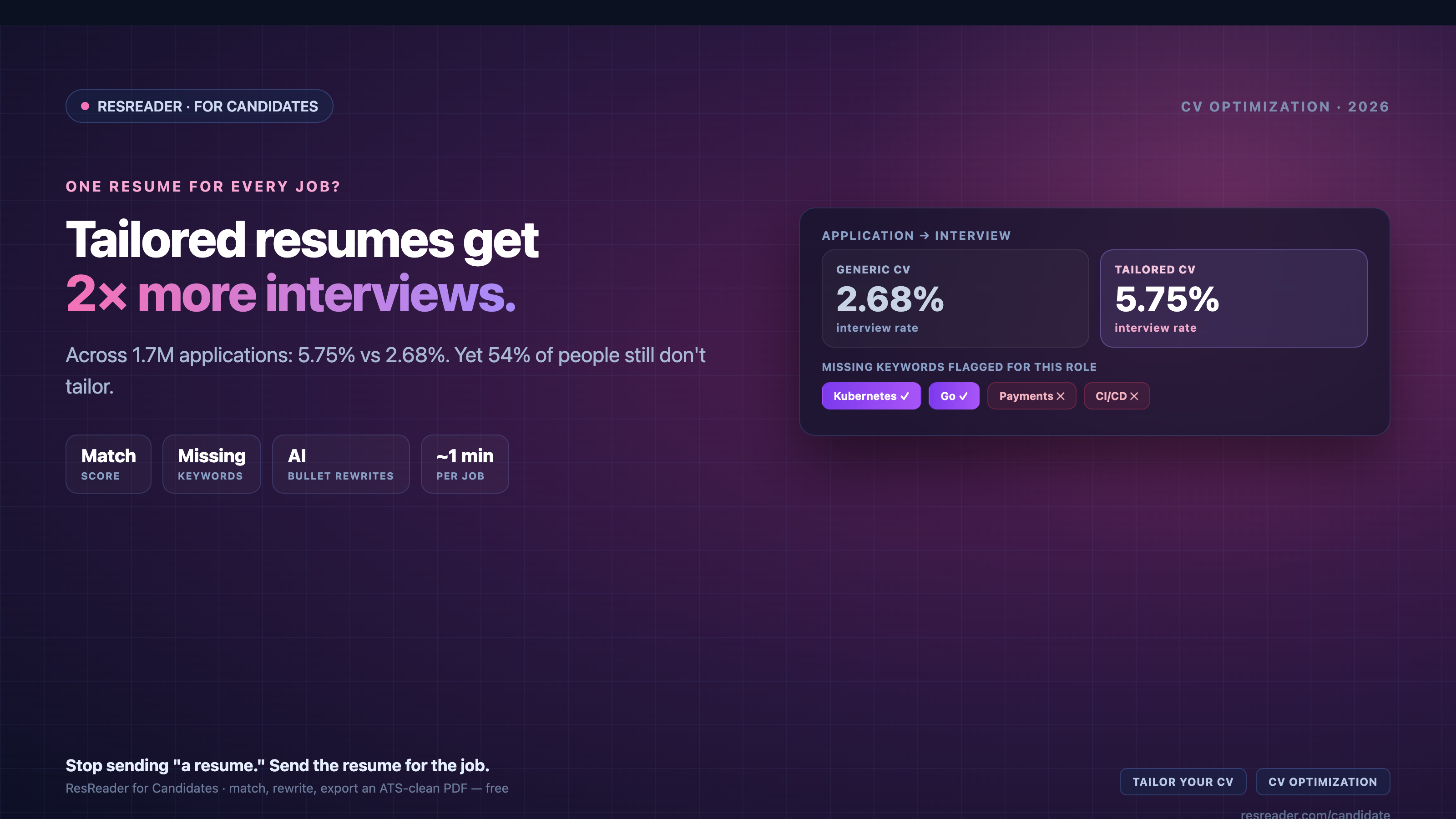
The data on this is blunt. In an analysis of 1.7 million applications, tailored resumes converted to interviews at 5.75%, versus 2.68% for generic ones — more than double. Other studies land in the same direction: tailored resumes are consistently far more likely to get you in the room. And yet 54% of candidates don't tailor their resume to the job at all — which means the fix is also one of the biggest untapped advantages in the whole job search.
Here's why it works, and how to do it fast.
What actually happens to your resume
Two gatekeepers read your resume before you get a call, and both reward tailoring:
- The ATS (and recruiter search). Nearly all recruiters use ATS keyword filters to search candidates, and about three-quarters rely on an ATS to screen. If your resume doesn't use the posting's exact terms, you rank lower — or don't surface at all. Many ATS guides suggest aiming for a 75–80%+ keyword match to be safe.
- The human, for about 8 seconds. Recruiters spend seconds on the first pass. In that glance they're scanning for evidence you fit this role. A resume that mirrors the posting's language reads as an obvious match; a generic one makes them work to connect the dots — and they usually won't.
Tailoring isn't gaming the system. It's making it easy for both gatekeepers to see what's already true: that you're a fit.
What "tailoring" actually means (it's not rewriting everything)
You don't rebuild your resume for every job. You adjust the parts that matter:
- Mirror the keywords. Read the posting and note the exact skills, tools, and phrases it repeats. If it says "stakeholder management" and you wrote "worked with teams," change it. If it lists "SQL," make sure "SQL" appears — spelled exactly that way.
- Reorder for relevance. Put the most role-relevant bullet points and skills near the top of each section. The strongest match should be the first thing seen, not buried in bullet six.
- Rewrite your top bullets to match. Turn vague lines into specific, keyword-aligned accomplishments. "Responsible for reports" becomes "Built weekly SQL dashboards that cut manual reporting time by 6 hours a week."
- Match the summary to the role. Your one-line summary should sound like it was written for this job — because it was.
The rule of thumb: every important keyword in the posting should have a truthful home somewhere in your resume, backed by a real accomplishment. No stuffing — modern systems and human readers both penalize a wall of disconnected terms.
Why people skip it — and how to not
Tailoring works, so why do 54% skip it? Because doing it by hand is slow: re-reading the posting, hunting for the gaps, rewording bullets, checking the match, exporting a clean file — for every application. Do that thirty times and you burn out by Tuesday.
That's exactly the problem ResReader's CV optimization solves. You paste your resume and the job description, and it:
- Scores the match and shows a keyword-coverage report — what the role asks for and what your resume is currently missing.
- Rewrites your bullets into stronger, role-matched versions that you accept or reject one by one, so nothing changes without your say-so.
- Exports a clean, ATS-readable PDF, so formatting doesn't scramble the work.
It turns a 30-minute manual chore into about a minute per job — which means you'll actually do it, for every application, instead of falling back on one generic CV.
The free plan includes 5 CV optimizations a month (plus 5 mock interviews), and it's built monthly — pay for the month you're actively applying and cancel when you land the offer.
Frequently asked questions
Does tailoring your resume to the job really work?
Yes. Across 1.7M+ applications analyzed by Huntr, tailored resumes converted to interviews at 5.75% versus 2.68% for generic ones — more than double, from the same underlying experience.
How do you tailor a resume to a job description?
Mirror the posting's exact keywords, move your most relevant experience to the top of each section, rewrite your top bullets into specific matched accomplishments, and align your summary to the role — with every keyword backed by a real result.
How long should it take to tailor a resume?
By hand, roughly 15–30 minutes per job. With an AI CV optimizer like ResReader, about a minute — which is what makes it realistic to do for every application.
The takeaway
The single biggest lever in your job search isn't a fancier template or more applications — it's tailoring the resume you already have to each specific role. The data says it more than doubles your interview rate, and more than half your competition isn't doing it. Match the keywords, lead with the most relevant experience, back every claim with a real result, and export something clean — for each job, not "jobs in general."
Want to see what a specific posting is missing from your resume — and fix it in a minute? Run a free CV optimization on ResReader.