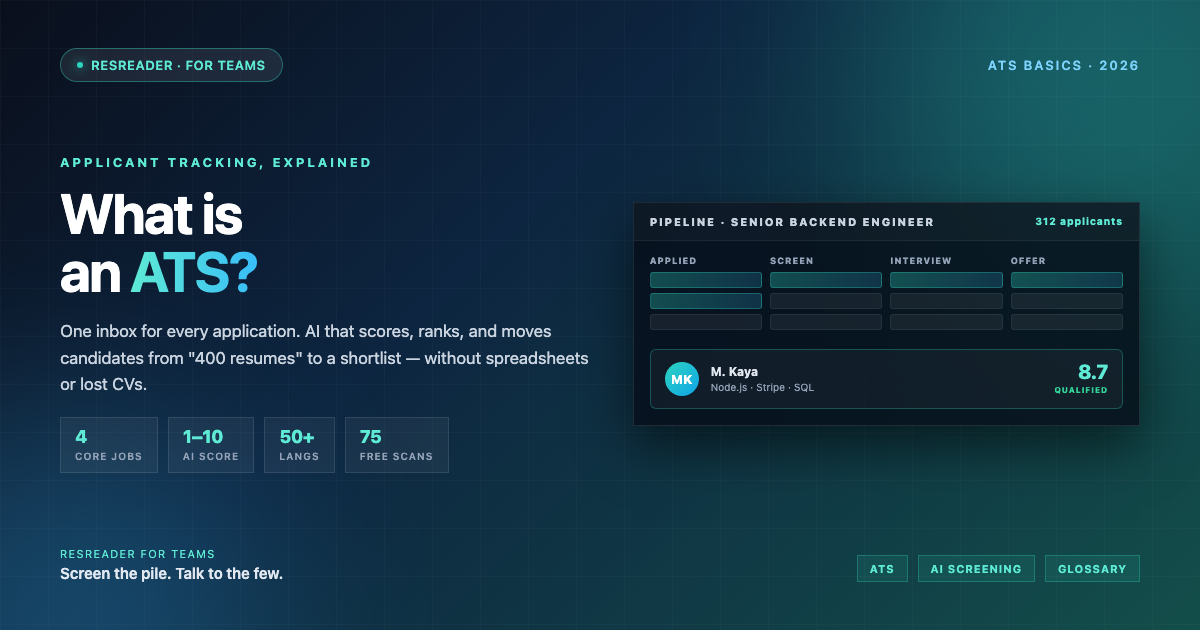
If you've ever posted one job and woken up to 300 resumes in your inbox, you already understand the problem an ATS solves. An applicant tracking system (ATS) is software that collects every application for a role in one place, helps you screen and rank candidates, and moves them through your hiring stages to an offer — without spreadsheets, lost CVs, or threads buried in email.
This guide explains what an ATS actually does, who needs one, what changed in 2026, and how to tell a lean tool from a heavy enterprise platform.
What an ATS does, in plain terms
At its core, an ATS handles four jobs:
- Collect — one application link or careers page funnels every candidate into a single inbox, no matter where they applied.
- Organize — resumes are parsed into structured fields (work history, skills, education) so you can search and filter instead of scrolling through PDFs.
- Screen — candidates are ranked against the role so you read the strongest first.
- Move — each candidate sits in a stage (Applied → Screen → Interview → Offer) so your team always knows what's next.
Everything else an ATS offers — interview scheduling, scorecards, rejection emails, analytics — sits on top of those four jobs.
What does ATS stand for?
ATS stands for Applicant Tracking System. The name is literal: it tracks applicants from the moment they apply to the moment they're hired or rejected. Some people also call it "recruiting software," "hiring software," or a "candidate management system" — same category, different label.
Who needs an ATS?
You probably need one the moment hiring stops fitting in your head. Common signals:
- You get more applicants per role than one person can read carefully.
- Multiple people interview the same candidate and need a shared view.
- You hire for several roles at once and lose track of who's where.
- Good candidates slip through because nobody followed up in time.
Small businesses, independent recruiters, staffing agencies, and in-house talent teams all hit this wall — just at different volumes. An ATS isn't an enterprise-only tool; the volume threshold matters more than headcount.
How AI changed the ATS in 2026
The first generation of applicant tracking systems was essentially a database with keyword search. If a resume didn't contain the exact word in your filter, a qualified candidate disappeared. That's where the "resumes go into a black hole" reputation came from.
Modern, AI-first systems work differently:
- AI scoring instead of keyword matching. Each resume gets a score against the role's real requirements — with the reasoning behind it, not just a number.
- Semantic search. Looking for a "frontend engineer" also surfaces a "React developer," because the system understands meaning, not just strings.
- Async AI video interviews. Candidates record answers in the browser on their own schedule; the system transcribes and scores each answer into a recruiter-ready scorecard.
- Cross-job matching. When you open a new role, the system can scan your existing resume bank and surface past applicants who already fit.
The result is less time spent reading and more time spent talking to the right people.
ATS features worth comparing
When you evaluate tools, look past the feature list and ask what each one actually removes from your week:
| Feature | What it removes |
|---|---|
| AI resume scoring with reasoning | Hours of manual first-pass reading |
| Async AI video interviews | Calendar back-and-forth for first-round screens |
| Bulk actions (invites, rejections, follow-ups) | Repetitive one-by-one emailing |
| Hosted careers page | Building and maintaining a jobs page yourself |
| Multi-language support | Manual translation across regions |
| Team workspaces | Forwarding candidates around in email |
Enterprise ATS vs. lean ATS — which do you need?
There is no universally "best" ATS — only the one that matches the bottleneck you're trying to remove.
- Enterprise platforms prioritize deep approval workflows, compliance reporting, and hundreds of integrations. They're powerful, expensive, and usually sales-gated.
- Lean, AI-first tools prioritize getting from "400 resumes" to "5 strong candidates" fast, with transparent pricing and a real free tier.
If your main pain is volume and screening, a lean tool wins. If it's enterprise process and compliance at scale, you'll want the heavier platform. (For a deeper breakdown, see our guide to the best ATS for small business in 2026.)
How ResReader fits
ResReader is an AI-first ATS built for teams whose bottleneck is screening, not bureaucracy. It scores resumes 1–10 against your role with per-criterion reasoning, runs async AI video interviews, hosts a careers page that Google for Jobs indexes automatically, and supports 50+ languages for analysis, candidate communication, and interviews. Anonymous screening can strip name and photo from the first pass to keep evaluation focused on substance.
It starts free — 75 scans a month, no credit card required — so you can see a scored shortlist before you decide anything. (Want the mechanics of the score? Read how AI resume screening works.)
Frequently asked questions
What does ATS stand for? Applicant Tracking System — software that collects, screens, and organizes job applications in one place.
Is an ATS only for big companies? No. The volume threshold matters more than headcount. A two-person team hiring for one popular role can drown in applications just as easily as an enterprise.
Does an ATS reject candidates automatically? A good one assists, it doesn't decide. ResReader scores and ranks candidates with transparent reasoning, but a person reviews and chooses. AI reduces bias and busywork; it doesn't replace your judgment.
Is there a free ATS? Yes — ResReader has a genuine free tier (75 scans per month, no card required).
What file types can an ATS read? ResReader accepts PDF, DOC, and DOCX resumes.
Looking for your next role? Open ResReader for Candidates →