You nailed the interview, walked out feeling good, and now you're wondering: do I send a thank-you email, or is that old-fashioned? Here's the thing — it's one of the easiest edges left in a job search, and most people skip it.
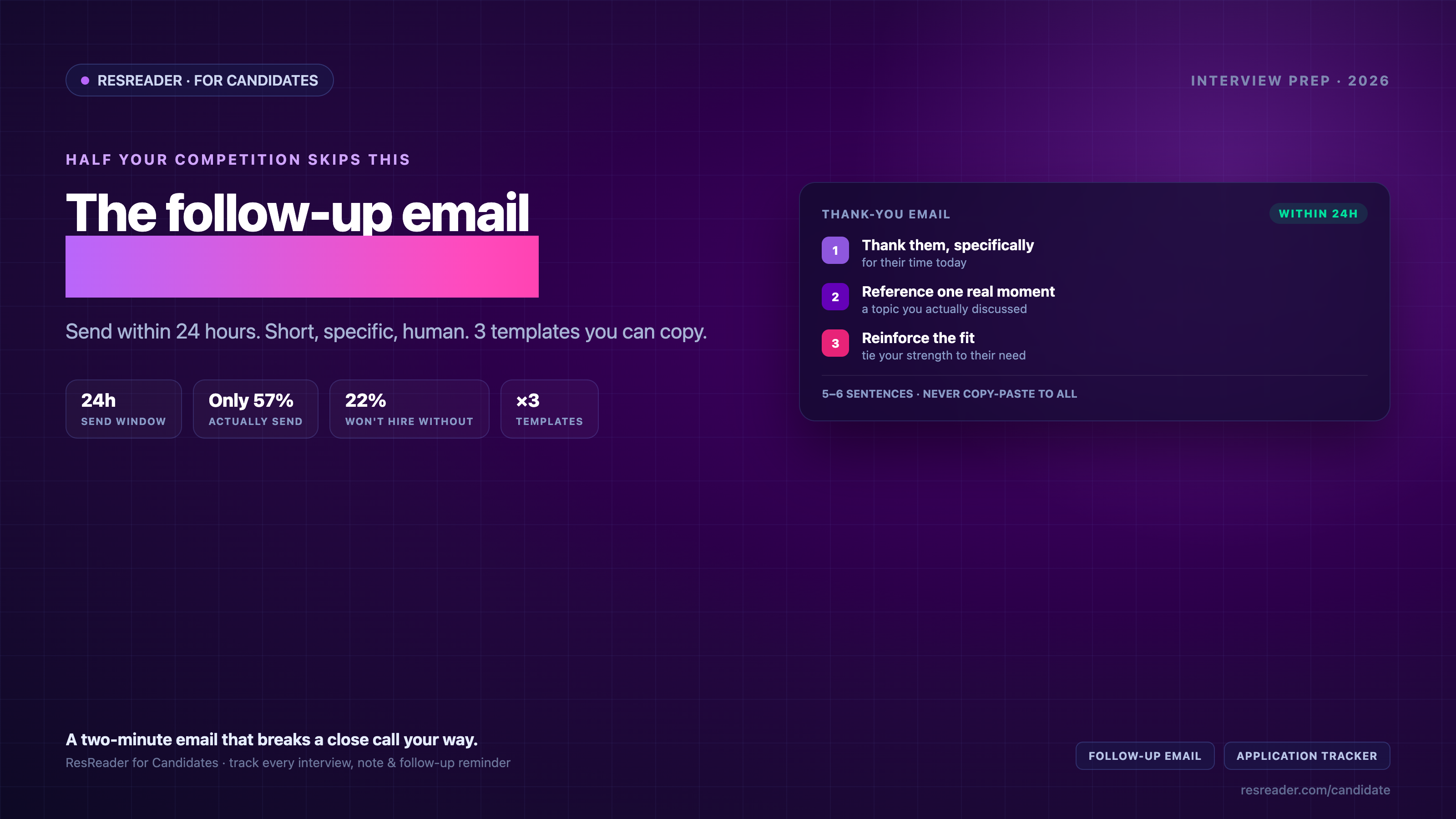
The numbers make the case on their own. Only 57% of candidates send a thank-you note after an interview — while 22% of employers say they're less likely to hire someone who doesn't (CareerBuilder survey). That's a huge, free advantage sitting on the table, and roughly half your competition is walking past it.
Why a two-minute email moves the needle
A follow-up email isn't about flattery. It does three quiet, useful things:
- It keeps you top of mind. Interviewers often see several candidates in a row. A thoughtful note lands in the inbox right as they're comparing people — and keeps your name warm.
- It signals initiative and interest. Employers read the absence of a thank-you as low enthusiasm. Sending one is a small proof that you actually want the role.
- It's a tiebreaker. When two candidates are close, the one who followed up well is easier to say yes to. It rarely wins the job alone — but it breaks ties.
Timing: the 24-hour rule
Send it within 24 hours of the interview. Same day is even better while the conversation is fresh. A thank-you note loses most of its value after 72 hours — by then the hiring team may already be deep into their decision, and a late note can read as an afterthought. If you interviewed with multiple people, send each a short, slightly different note rather than one copy-pasted to all.
What to actually write
A strong follow-up is short — five or six sentences — and hits four beats:
- Thank them for their time, specifically.
- Reference one real moment from the conversation — a topic you discussed, a challenge they mentioned. This proves you were present and makes the note un-generic.
- Reinforce your fit in one line — tie your strength to a need they raised.
- Close warmly and signal you're happy to share anything else.
Keep it human. A note that reads like a template is barely better than no note at all.
Three templates you can copy
1. Standard thank-you (send within 24h):
Subject: Thank you — [Role] interview
Hi [Name], thanks so much for taking the time today. I really enjoyed our conversation, especially digging into [specific topic they raised]. It reinforced how well my experience with [relevant skill/result] lines up with what you're building on the team. I'd be glad to share anything else that would help — thanks again, and I hope to stay in touch. — [Your name]
2. When you forgot to mention something:
Hi [Name], thank you again for today. One thing I wish I'd added: when you mentioned [challenge], it reminded me of [specific relevant experience + result]. I'd have brought that to [the problem] here too. Happy to expand if useful — thanks for the great conversation. — [Your name]
3. Checking in after silence (7–10 days, no reply):
Hi [Name], I wanted to follow up on our conversation about the [Role] on [date]. I'm still very excited about the opportunity and the chance to help with [specific goal]. Is there any update on timing, or anything else you need from me? Thanks so much. — [Your name]
Don't let the follow-up fall through the cracks
The reason so many people skip the thank-you isn't laziness — it's that after a few interviews, the details blur and the follow-ups slip. That's exactly what an application tracker is for. ResReader's application tracker keeps every interview, note, and follow-up reminder in one place, so you never lose track of who to thank, when a check-in is due, or where each application stands.
And if you want the content of your answers to be worth following up on, ResReader's AI mock interviews help you nail the conversation itself first — because the best follow-up in the world can't rescue a weak interview.
Frequently asked questions
Should you send a thank-you email after an interview?
Yes. Only 57% of candidates do, but 22% of employers are less likely to hire someone who doesn't — so it's a low-effort, high-upside habit that can break a tie in your favor.
How long after an interview should you send a follow-up email?
Within 24 hours — same day if you can. After about 72 hours it loses most of its impact, since the hiring team may already be making their decision.
What should a follow-up email include?
A specific thank-you, a reference to a real moment from the conversation, one line reinforcing your fit, and a warm close. Keep it to five or six sentences and personalize it per interviewer.
The takeaway
The follow-up email is one of the last easy wins in job hunting: half your competition skips it, and a meaningful chunk of employers hold it against them. Send a short, specific, genuinely human note within 24 hours, personalize it to each interviewer, and keep your follow-ups organized so none slip. It won't win the job on its own — but it's a two-minute way to tilt a close call your way.
Keep every interview, note, and follow-up in one place. Try ResReader for Candidates free.