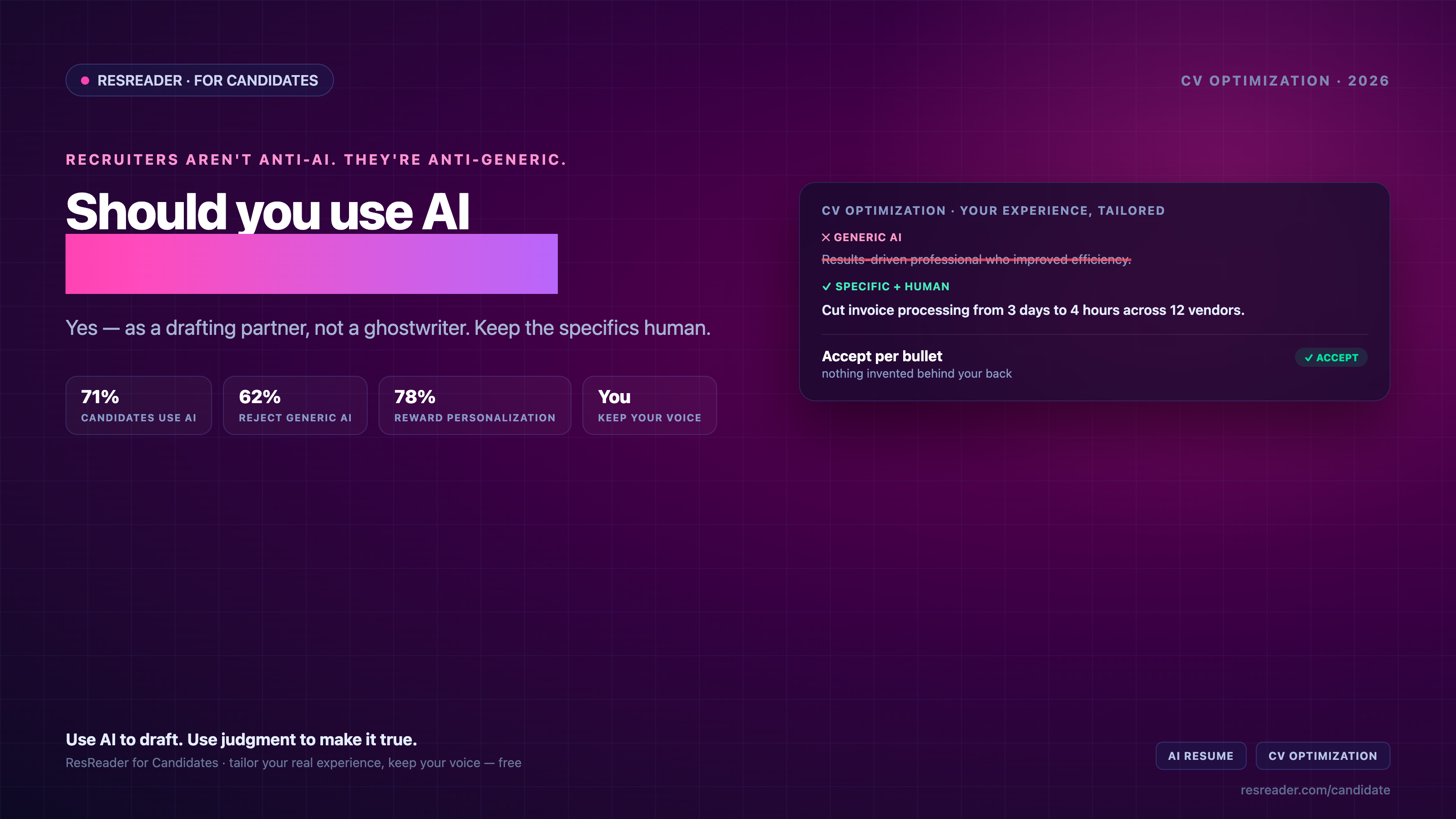
You've probably already done it — pasted a job description into ChatGPT and asked it to write or "improve" your resume. So has almost everyone else: 71% of candidates said they use AI on their resumes (HireVue 2026 Global AI in Hiring report). Which raises the obvious anxiety: if a recruiter can tell, does it hurt you?
Here's the honest answer, straight from recruiters: they don't care that you used AI. They care whether your resume is honest, specific, and actually about this job. The tool isn't the problem. Generic is the problem.
What recruiters actually reject
The data is clear that AI itself isn't the red flag. As long as your resume is accurate — no fake experience, no inflated titles, no skills you don't have — recruiters generally don't care how it was drafted. What they do reject is the tell-tale signature of lazy AI use:
- 62% of employers reject AI-generated resumes that lack personalization (Resume Now survey, 925 U.S. HR professionals).
- 78% of hiring managers say personalized, specific details are the strongest signal of genuine interest and fit (Resume Now).
And they can spot generic AI a mile off. The giveaways recruiters keep naming: executive summaries that read like carbon copies, odd turns of phrase no human says out loud, vocabulary a notch too fancy for the role, and entry-level candidates suddenly writing like seasoned vice presidents.
So the risk isn't "you used AI." The risk is "you shipped whatever the AI gave you without making it yours."
The trust gap nobody mentions
Here's the strange part of 2026: everyone's using AI and nobody fully trusts it. The same report found 77% of hiring teams use AI too — but only about 41% fully trust the tools. Both sides of the table are leaning on AI while quietly side-eyeing it.
For you, that means the bar has shifted. When every applicant can generate a polished, keyword-matched resume in thirty seconds, polish is no longer a differentiator — it's the baseline. What stands out now is the opposite of what AI does by default: specific, verifiable, human detail.
The winning approach: drafting partner, not ghostwriter
The candidates who win with AI use it as a drafting partner, not a ghostwriter. Concretely:
- Let AI handle structure and language. Cleaning up phrasing, fixing formatting, catching gaps, aligning keywords to the job — this is exactly what AI is good at.
- Keep the specifics unmistakably human. The numbers, the project names, the actual outcomes — these have to come from you. "Improved efficiency" is AI filler. "Cut invoice processing time from 3 days to 4 hours" is you.
- Read every single line and verify it. If you can't explain or defend a bullet in a live interview, it doesn't belong on the page. AI sometimes inflates; you're the fact-checker.
- Personalize for the specific job. Generic is the one thing recruiters actively reject. The resume should read like it was written for this posting — because a human made sure it was.
Use AI to draft; use your judgment to make it true and specific. That's the whole game.
Where ResReader fits
This is exactly the line ResReader's CV optimization is built to walk. Instead of generating a resume from scratch (the thing recruiters reject), it takes your real experience and tailors it to a specific job:
- It reads the job description and shows a keyword-coverage report — what the role wants and what your CV is missing.
- It suggests rewrites of your own bullet points, which you accept or reject one by one — so the specifics and your voice stay yours. Nothing gets invented behind your back.
- It exports a clean, ATS-friendly PDF.
And because you'll have to back up every claim out loud, ResReader's AI mock interviews let you rehearse defending your resume before a real interviewer asks "tell me more about that." AI-polished words can't fake a spoken answer about a real project — so make sure yours is real, then practice saying it.
Frequently asked questions
Can recruiters tell if you used AI to write your resume?
Often yes — generic AI resumes have tells (carbon-copy summaries, oddly formal phrasing, vocabulary too advanced for the role). But recruiters don't reject you for using AI; they reject resumes that are generic, inflated, or clearly not personalized to the job.
Is it bad to use ChatGPT to write your resume?
Not if you use it as a drafting partner and keep the content honest and specific. It's bad if you submit whatever it generates without personalizing it, verifying every claim, and making sure the details are truly yours.
How do you use AI on a resume the right way?
Let AI handle structure, phrasing, and keyword alignment, but supply the real metrics, project names, and outcomes yourself. Read every line, tailor it to the specific job, and make sure you can defend each point in an interview.
The takeaway
Should you use AI to write your resume? Yes — but as a co-writer, not a ghostwriter. Recruiters aren't screening for AI; they're screening out generic. Use AI to get the structure and keywords right, then make every specific detail real, human, and tailored to the exact job. Do that, and AI becomes an edge instead of a liability.
Want AI that tailors your real experience — without inventing anything? Try ResReader's free CV optimization.