Bulk Rejection Email Templates That Don't Burn Your Employer Brand
If you've ever opened a folder of 200 applications, accepted three for a phone screen, and then closed the tab on the rest, you already know the problem. The 197 candidates you didn't move forward deserve a reply — but writing each one takes ninety seconds, and you don't have five hours.
So most teams either send nothing (which silently burns your employer brand) or send a form letter that's so generic it does the same damage with a friendlier face. The fix is a small set of templates that are specific enough to feel human, plus a bulk workflow that keeps each one personalized at scale.
Below are eight templates we use ourselves, broken out by stage of the funnel, plus the workflow that turns them into a single click instead of an afternoon of copy-paste.
A short rule before the templates
Every rejection email worth sending has three things, and almost none of the bad ones do:
- A clear no. Not "we'll keep you on file," not "we'll be in touch about other opportunities." A real no, said plainly, so the candidate can move on.
- A reason, even briefly. "We moved forward with candidates whose direct PostgreSQL production experience was closer to what the role needed" beats "after careful consideration." The first respects the candidate's time; the second insults it.
- One sentence of warmth that's not a lie. If you genuinely enjoyed the conversation, say so. If you didn't, just leave it out — fake warmth is worse than no warmth.
Templates that ignore these read as form letters, and candidates can tell from the second line.
Eight templates by stage
1. After resume screen — early-stage no, role wasn't a match
Subject: Your application for [Role] at [Company]
Hi [First Name],
Thanks for taking the time to apply for the [Role] position at [Company]. We've reviewed your background and won't be moving forward with your application this time.
To be specific: we were looking for [specific must-have skill or experience from the JD], and the applications we're advancing demonstrated more direct experience there. That's not a judgment on your overall background — just on fit for this particular role.
We'll keep your details in our system, and if a closer match opens up we'll reach out. In the meantime, thanks again for your interest in [Company].
Best, [Your Name] [Title]
2. After resume screen — overqualified
Subject: Your application for [Role] at [Company]
Hi [First Name],
Thank you for applying for the [Role] position. After reviewing your background, we won't be moving forward — but the reason is unusual enough that I wanted to be direct about it.
Your experience is significantly above what we're hiring for at this level. We're concerned about the role being a long-term fit at this band, and that's not a problem we can solve at the screening stage.
If we open something more senior, you'll be one of the first people I email. Thanks again for your time and interest.
Best, [Your Name] [Title]
3. After resume screen — bulk, role closed
Subject: Update on the [Role] position at [Company]
Hi [First Name],
Thanks for your application for the [Role] position. We've now closed the role with a candidate already in the final stages, and we won't be moving any new applications forward.
This isn't a reflection on your background — most of the candidates we're emailing today were strong on paper, and we simply needed to close the search. We'll keep your information in case a similar role opens up.
Thanks again for your interest in [Company].
Best, [Your Name] [Title]
4. After phone screen / first interview
Subject: Following up on your interview for [Role]
Hi [First Name],
Thanks again for taking the time to speak with [Interviewer Name] last week. I'm writing to let you know we won't be moving forward with your candidacy for the [Role] position.
The conversation surfaced [one specific factor — e.g., "less hands-on time with X than the role demands," or "a stronger fit pattern with a different candidate's experience in Y"]. That's not a knock on your overall profile — it's specific to what this particular role needs.
We'd be glad to keep in touch if a future role looks like a better fit. Thanks for the time and the thoughtful conversation.
Best, [Your Name] [Title]
5. After take-home or technical assessment
Subject: Update on your [Role] application
Hi [First Name],
Thank you for the time you put into the technical exercise for the [Role] position. We've reviewed it carefully and won't be moving you forward.
The deciding factor was [one specific area — e.g., "the depth of the database design section relative to what the role's first six months will demand"]. There were parts we genuinely liked — [one specific positive, if true].
If you'd like brief written feedback on the submission, reply to this email and I'll send notes. Otherwise, thanks again for the work and best of luck with your search.
Best, [Your Name] [Title]
6. After final round — close call, second-place candidate
Subject: Update on your final interview for [Role]
Hi [First Name],
I want to start by saying: this was a close decision, and the rest of this email reflects that.
We've made an offer to another candidate for the [Role] position. The conversation came down to [specific dimension — e.g., "the depth of past experience leading on-call rotations at the volume this team operates at"], and we ultimately moved with the candidate who had a stronger track record there specifically.
You impressed several people on the panel. If we open a comparable role in the next few months, I'd genuinely like to revisit your candidacy directly — would you be open to that?
Thanks for putting so much into this process. It mattered.
Best, [Your Name] [Title]
7. After offer was declined — role re-opened, candidate from earlier round
Subject: Following up on your earlier application for [Role]
Hi [First Name],
We spoke earlier this month about the [Role] position. The role is open again — our first-choice candidate accepted a different offer — and I wanted to come back to you directly before we re-post it.
Would you be open to a short conversation about whether the timing now works for you? If so, reply with two or three time windows that suit you and I'll get something on the calendar.
Either way, thanks again for your patience with the process.
Best, [Your Name] [Title]
8. Auto-rejection for clear non-matches (very high-volume only)
Subject: Your application for [Role] at [Company]
Hi [First Name],
Thanks for applying to [Company]. We've reviewed your application and won't be moving it forward.
For this role, we specifically need [one or two non-negotiable requirements, e.g., "five years of production PostgreSQL experience" or "current work authorization in the EU"], and your application didn't show those. That's not a judgement on your overall background.
We're not able to provide individual feedback on every application at this stage, but we appreciate your interest.
Best, [Company] Recruiting Team
How to send these at scale without losing the personalization
The trap with rejection templates is that the moment you send them in bulk, they sound like a form letter — and candidates can spot one from a single sentence in.
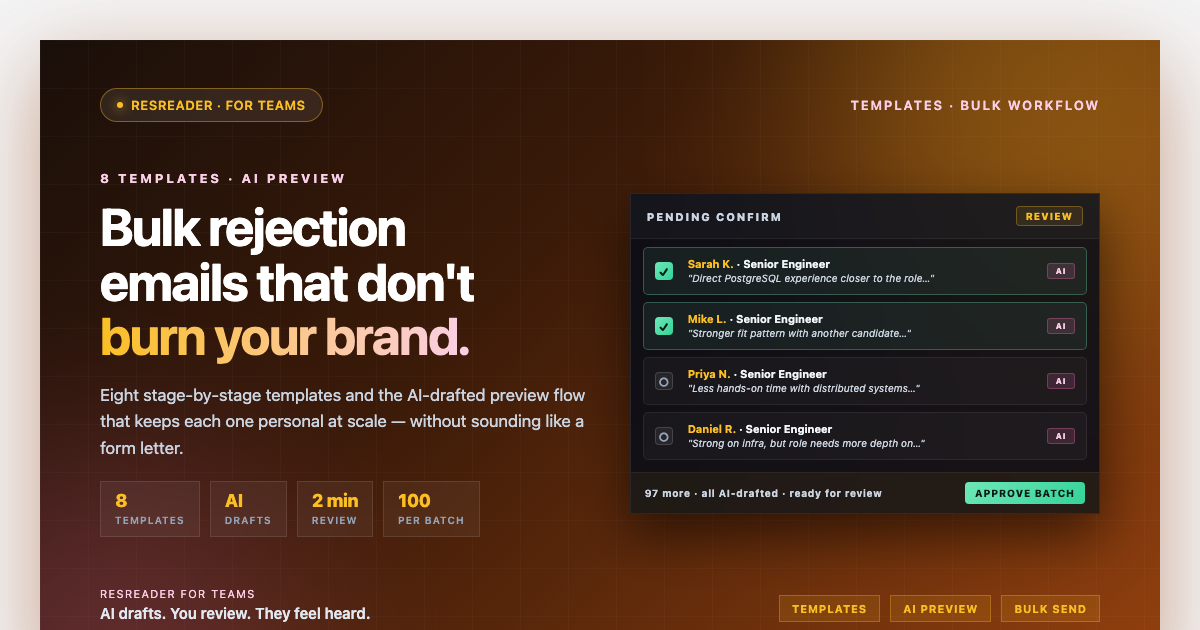
The way around that, in ResReader, is the bulk rejection email flow. It looks like this:
- Select candidates to reject from the analysis page (filter by score, by stage, by qualified/not-qualified status).
- Choose how the email is written. You have two options:
- AI drafts each one individually. The AI reads each candidate's resume and the job description, then writes a personalized rejection email naming the specific reason that candidate isn't moving forward.
- You give the AI a reason in plain English. Type "we needed more direct experience with distributed systems" and the AI rewrites it into a professional email per candidate, anchored to that reason.
- Preview before send. Every email lands in a review queue. You see each one with the candidate's name and the proposed body, and approve or skip them one by one. Nothing leaves the building until you've reviewed it.
- Approve the batch. Approved emails go out from ResReader to the candidate's address. Each one is personalized but the whole batch takes about two minutes to review for a hundred candidates instead of two and a half hours to write from scratch.
The reason this works as a bulk flow is that the AI is doing the first draft and you're doing the review. You're not surrendering taste to the AI — you're getting back time spent on first drafts that all said roughly the same thing anyway.
A few practical notes from teams using it:
- Don't auto-send. Always preview. The AI is good but not perfect; if it generates one email that misnames the role or hallucinates a project, you want to catch it before it ships.
- Use the "reason in plain English" mode for stage-bulk rejections (after screening, after first interview). Use the per-candidate AI mode for the more personal closes — second-place candidates, take-home reviewers — where the reasoning genuinely is different per person.
- If you want to follow up with a Twilio SMS later (e.g., "we have a new role you'd be a fit for, want to talk?"), that's a separate flow in ResReader and intentionally not bundled with rejection email — different purpose, different consent expectation.
What to avoid
A short list of things teams do with bulk rejection that quietly damage their hiring funnel:
- "We'll keep your resume on file." Don't say it unless you actually re-open candidate searches against past applications. If you do — ResReader's AI Job Matching can scan your resume bank against new roles and surface past applicants who fit — then saying it is honest. If you don't, it reads as a brush-off.
- "After careful consideration." The most overused four words in rejection email history. They're a tell that nothing specific is coming. Skip them.
- Sending only "yes" emails and ghosting the "no" pile. Silent rejections are the single biggest source of bad reviews on Glassdoor and Indeed. The cost of a one-paragraph email is essentially zero if it's automated; the cost of silence shows up in your apply rate six months later.
- Form letters that try to sound personal. "We were really impressed with your unique background" lands worse than "we won't be moving forward." If you can't be specific, be brief and honest.
The shortest possible summary
If you send rejection emails at all, you're already ahead of most teams. If you send rejection emails that name a specific reason, you're ahead of almost all of them. Templates make the volume manageable; the AI-assisted bulk workflow keeps each one personal enough to feel like a human wrote it.
The candidates you reject today are the candidates you'll re-recruit in two years when a closer role opens up. They remember how you closed the loop.
If you want to see the bulk-rejection-with-preview flow in your own pipeline, ResReader's free plan includes 75 AI scans per month — no credit card.
Looking for your next role? Open ResReader for Candidates →