You've narrowed it down to three finalists. All three are qualified. All three interviewed well. Now comes the hardest part of hiring: making the final decision.
Too often, this decision comes down to gut feeling, recency bias, or whoever the last interviewer spoke with. There's a better way.
The Problem with Subjective Comparisons
Research shows that hiring decisions are plagued by cognitive biases:
- Recency bias — Favoring the candidate you interviewed most recently
- Halo effect — One strong trait (great university, impressive company) colors the entire evaluation
- Similarity bias — Preferring candidates who remind you of yourself
- Anchoring — Over-weighting the first piece of information you learn about a candidate
- Contrast effect — Evaluating candidates relative to each other rather than against job requirements
These biases aren't intentional — they're human. The solution isn't to eliminate human judgment, but to support it with objective data.
Building an Objective Comparison Framework
Step 1: Define Your Criteria Before Interviewing
Before you start evaluating, write down:
- Must-have skills — Non-negotiable requirements
- Nice-to-have skills — Differentiators, not disqualifiers
- Weight of each criterion — Is technical depth worth more than communication?
- Minimum thresholds — What score is "good enough" in each area?
This prevents you from unconsciously shifting criteria to favor a preferred candidate.
Step 2: Use Structured Scoring
Rate every candidate on the same dimensions using the same scale. ResReader's AI interviews provide this automatically:
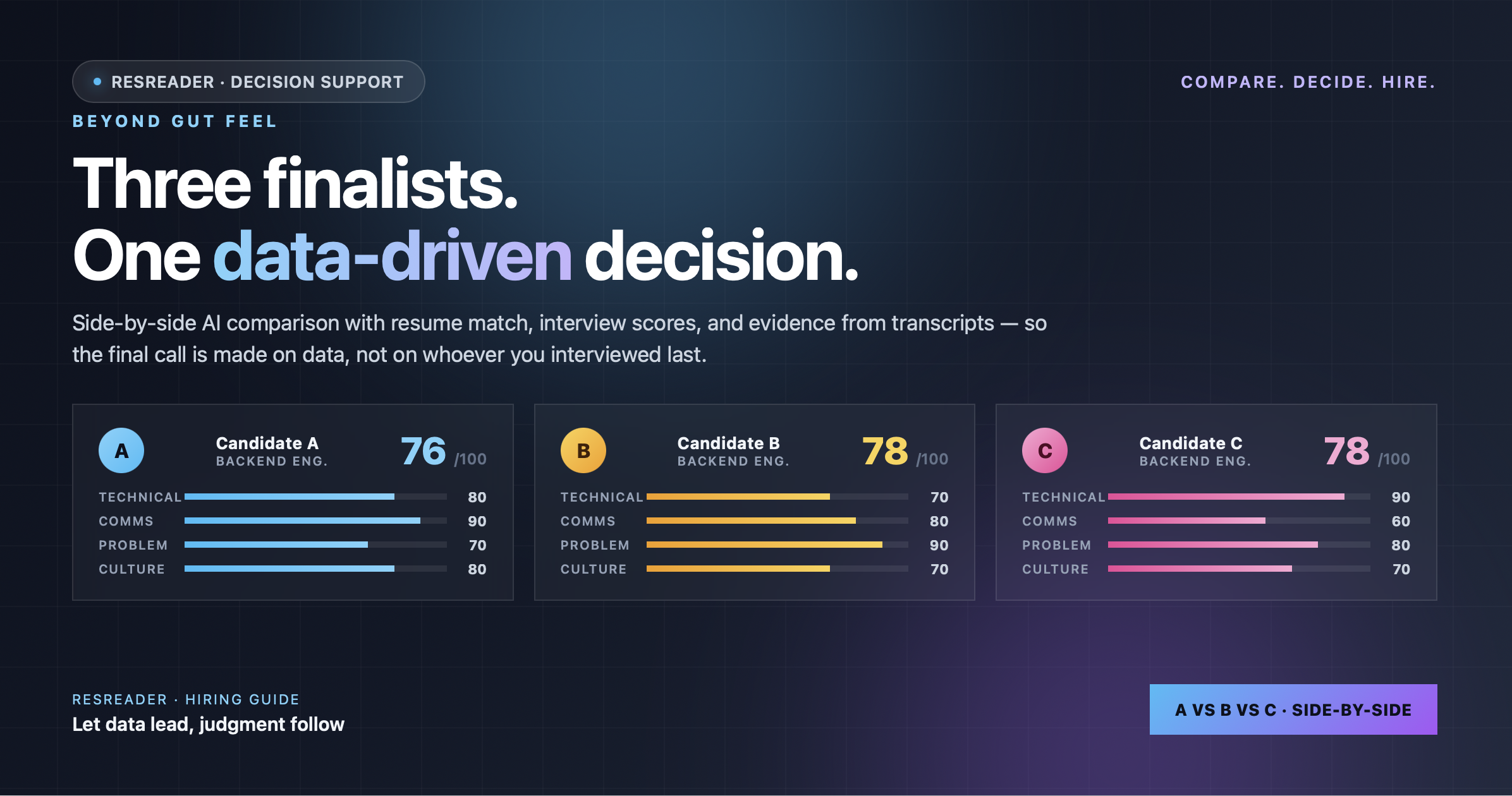
| Dimension | Candidate A | Candidate B | Candidate C |
|---|---|---|---|
| Technical Skills (0-100) | 80 | 70 | 90 |
| Communication (0-100) | 90 | 80 | 60 |
| Problem Solving (0-100) | 70 | 90 | 80 |
| Culture Fit (0-100) | 80 | 70 | 70 |
| Experience (0-100) | 60 | 80 | 90 |
| Weighted Average | 76 | 78 | 78 |
When scores are close, dig into the details.
Step 3: Use AI-Powered Comparison
ResReader's comparison tool takes this further:
- Select 2-3 candidates from your dashboard
- Click "Compare"
- AI generates a comprehensive analysis covering:
- Resume match scores with detailed breakdowns
- Interview performance with evidence from transcripts
- Follow-up response quality (if applicable)
- Strengths and weaknesses with specific examples
- Head-to-head recommendation
Step 4: Add Custom Comparison Criteria
You can add a custom prompt to focus the comparison:
"Compare these candidates specifically on their experience with distributed systems and their potential for growth into a tech lead role within 2 years."
This lets you zero in on what matters most for your specific situation.
What Good Comparison Data Looks Like
A useful comparison goes beyond scores. It answers:
For each candidate:
- What specific evidence supports their scores?
- Where did they excel in the interview?
- Where did they struggle?
- What risks does hiring them present?
- What unique value do they bring?
Between candidates:
- Who is stronger in the areas that matter most for this role?
- Who showed more growth potential?
- Who would ramp up faster?
- What are the trade-offs?
Real-World Decision Scenarios
Scenario 1: Close Scores, Different Strengths
Candidate A: Technical 90, Communication 60 Candidate B: Technical 70, Communication 90
Ask yourself: What does this role need more? For a senior backend engineer, maybe technical depth wins. For a client-facing technical lead, communication might matter more.
Scenario 2: One Strong Signal, Everything Else Average
Candidate A: All 70s and 80s across the board Candidate B: Technical 100, everything else 50-60
The balanced candidate is usually the safer hire. The specialist might be better for a highly technical, individual contributor role.
Scenario 3: Great Resume, Weak Interview
Candidate A: Strong resume (9/10 match), weak interview (50/100 average) Candidate B: Average resume (6/10 match), strong interview (80/100 average)
Interview performance is a better predictor of job success. But consider: was the candidate nervous? Was it a bad day? The transcript and recording let you investigate.
Comparison History: Learn from Past Decisions
ResReader saves all comparisons in your comparison history. Over time, you can review past decisions and learn:
- Were your comparisons predictive of actual performance?
- Are you consistently over-valuing certain traits?
- Which comparison criteria mattered most for successful hires?
This creates a feedback loop that improves your hiring decisions over time.
Making the Final Call
After gathering all the data:
- Review the AI comparison — Understand the objective differences
- Check your criteria — Does the data align with your pre-defined requirements?
- Discuss with your team — Share comparison reports for alignment
- Trust the data, but use your judgment — AI provides the evidence; you make the call
- Document your reasoning — For future reference and to improve your process
The best hiring decisions are informed decisions. Let data lead, and judgment follow.