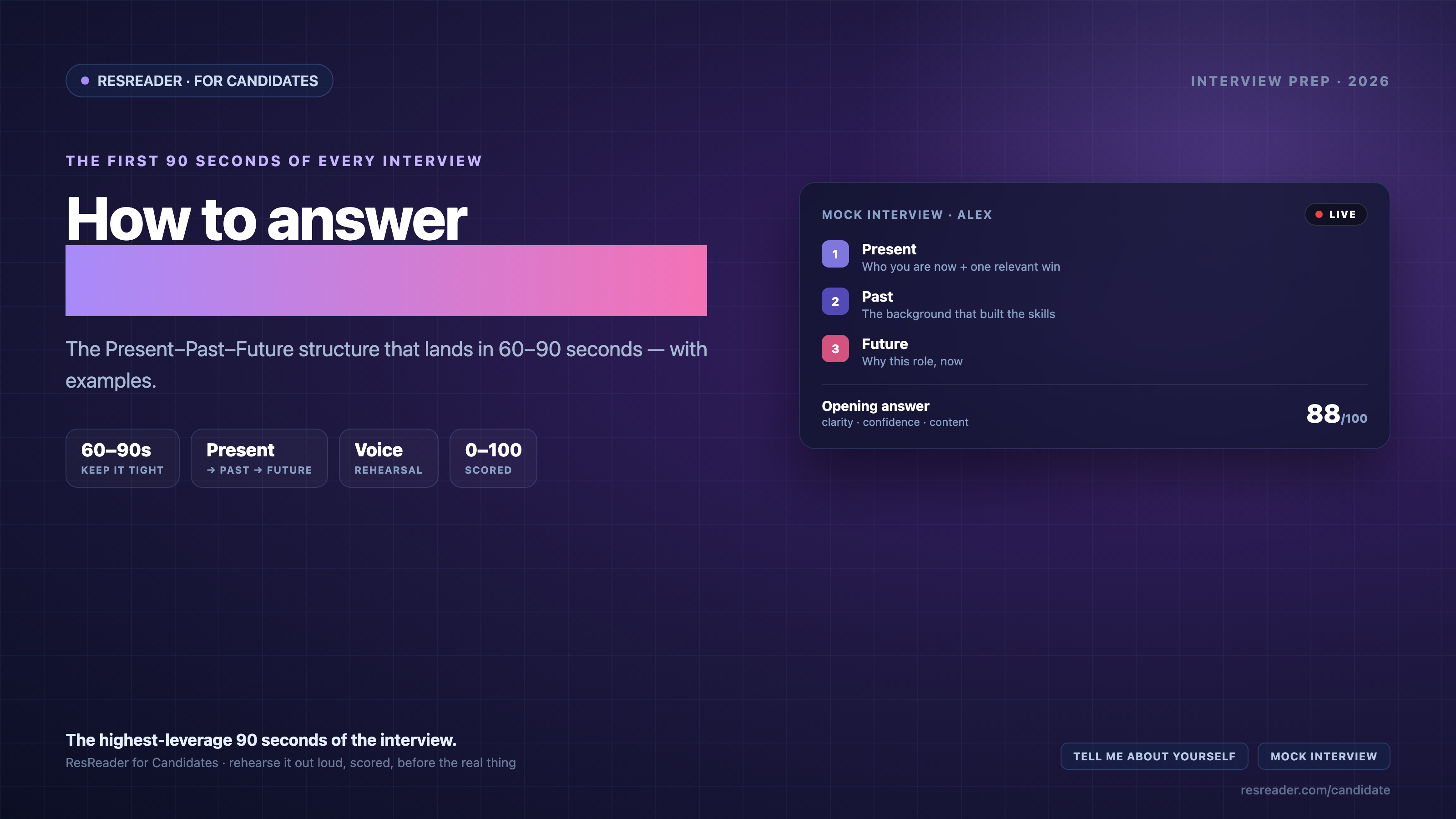
Quick answer: Answer "tell me about yourself" in 60–90 seconds using the Present–Past–Future structure: who you are now plus one relevant recent win (Present), the background that built the skills this role needs (Past), and why this specific role/company is your next step (Future). Keep it about your professional self, lead with what you can do (not a CV walk-through), and rehearse it out loud until it's tight — because it sets the tone for everything after it.
It's almost always the first question. It feels easy, so most people don't prepare it — then they ramble for three minutes, recite their CV top to bottom, or freeze and start with "um, well, I was born in…". The opening answer sets the interviewer's first impression and your own nerves for the rest of the call. It's the highest-leverage 90 seconds in the whole interview.
What the interviewer is actually asking
They're not asking for your life story. They're asking: can you tell me, clearly and concisely, why you're a fit for this role? It's secretly a test of three things at once — your communication, your judgment about what's relevant, and your fit. A rambling answer fails the first two before you've said anything about your experience.
The structure: Present → Past → Future
This framework works because it's easy to follow and ends pointing at the job.
1. Present — who you are now. Your current role and one recent, relevant achievement. A number helps.
"I'm a backend engineer at a fintech startup, where I most recently rebuilt our payments service to handle 4M transactions a day."
2. Past — the background that built you. One or two prior experiences that gave you the skills this role needs. Not everything — just the line that connects to this job.
"Before that I spent three years at a logistics company going deep on distributed systems and on-call ownership, which is where I learned to design for reliability under real load."
3. Future — why this role, now. Connect your path to this specific company and role. This is the part that signals intent.
"Now I'm looking to bring that payments and reliability experience somewhere it's core to the product — which is exactly why this role stood out."
Strung together that's ~45 seconds. Add one more sentence of color and you're at a tight 60–90.
Keep it to 60–90 seconds
Aim for roughly 150–200 words. Under a minute can feel thin; past two minutes you've lost them. If you can't say it in 90 seconds, you haven't decided what matters yet — and deciding what matters is the skill being tested.
Mistakes that sink the answer
- The full CV walk-through. Chronological "then I did this, then I did that" is a monologue, not an answer. Curate.
- Starting personal. Hometown, hobbies, family — save it unless asked. Lead with the professional.
- Being vague. "I'm a hard worker and a people person" says nothing. Specifics and one number beat ten adjectives.
- No connection to the role. If your answer would fit any job, it fits none. The Future step is what makes it land.
- Memorizing it word-for-word. Rehearsed beats robotic. Know the beats, not the script — so a follow-up doesn't derail you.
A full example (≈80 seconds)
"I'm a product marketer at a B2B SaaS company, where I run our launch program — most recently a launch that drove 30% of last quarter's pipeline. Before that I started on the content side, which is where I learned to turn a messy feature list into a story a buyer actually cares about. Over time I moved closer to the revenue side because I liked owning the number, not just the words. Now I'm looking for a role where launches are central to growth and I can own that end to end — and from the job description, that's exactly what this is."
Present, past, future. One number. Ends on the role. Nothing wasted.
Rehearse it the way you'll deliver it — out loud
Reading this and nodding won't help on the day. The answer that sounds polished in your head falls apart the first time you say it under pressure. You have to hear yourself say it a few times.
ResReader's mock interview is built for exactly this: paste the job description, optionally add your CV, and have a real voice-and-video conversation with an AI interviewer named Alex — who opens with this exact question, follows up if your answer wanders, and scores you afterward on clarity, confidence, and content. Run it twice: once to hear your rough version, once to deliver the tightened one. By the real interview, your first 90 seconds are automatic.
The free plan includes 5 mock interviews per month, no credit card — enough to nail your opener for the roles that matter.
Try it
Open ResReader for Candidates, paste the job you're prepping for, and let Alex ask you "tell me about yourself" before the real interviewer does.
FAQ
How long should "tell me about yourself" be? 60–90 seconds, roughly 150–200 words. Long enough to cover present, past, and future; short enough to stay sharp.
What structure should I use? Present–Past–Future: who you are now plus a relevant win, the background that built your skills, and why this specific role is your next step.
Should I mention personal details? Lead with the professional. A brief personal note at the end is fine if it's relevant, but the interviewer is asking about what you can do.
What's the most common mistake? Reciting your whole CV chronologically. It turns the answer into a monologue and shows weak judgment about what matters. Curate to what fits this role.
How do I practice it? Out loud, a few times, ideally under realistic conditions. ResReader's free mock interview (5/month) opens with this question, follows up, and scores your answer so you can tighten it before the real thing.