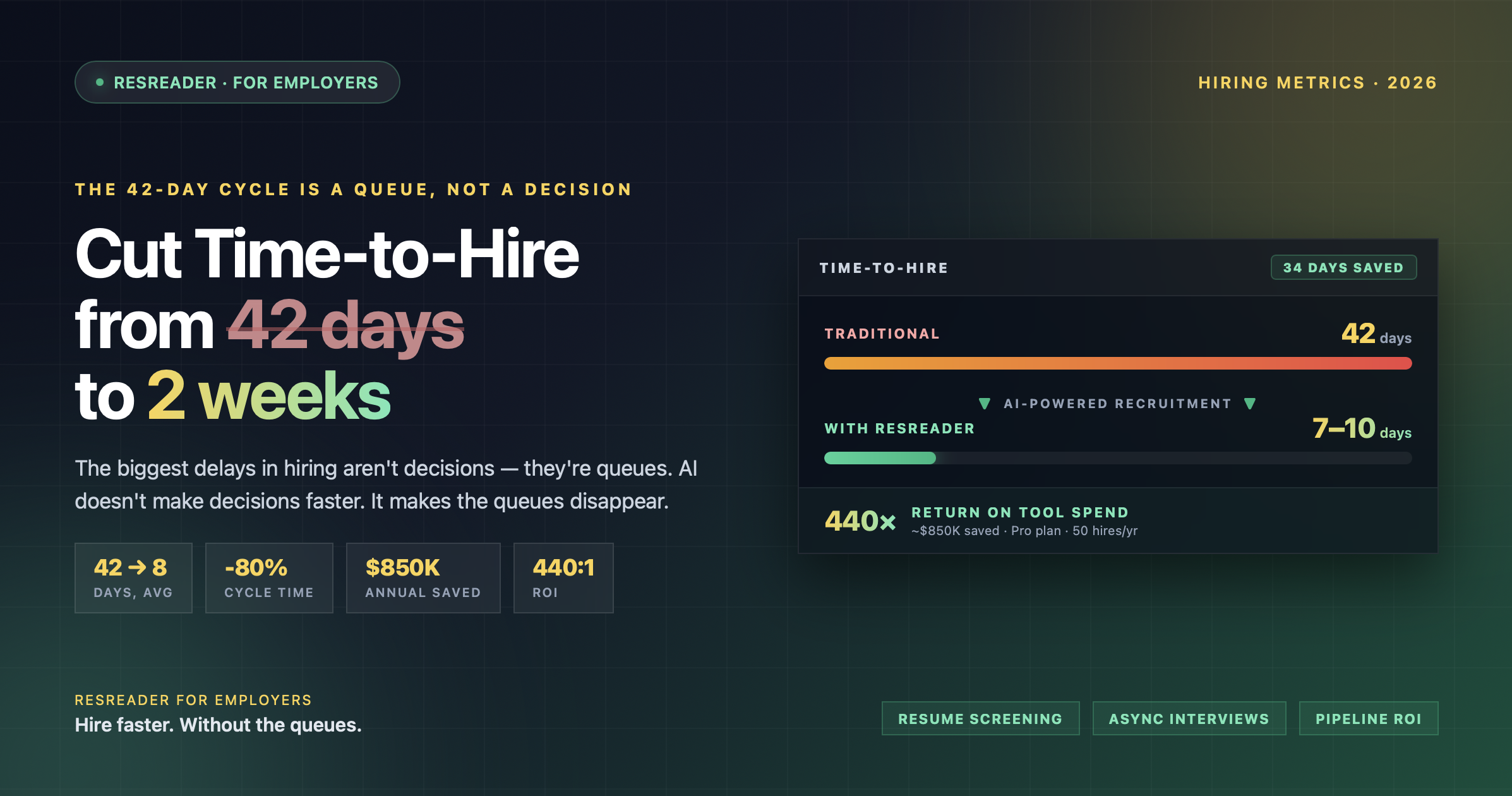
How to Cut Time-to-Hire from 42 Days to 2 Weeks with AI Recruitment Tools
The average time-to-hire in the U.S. is 42 days. For technical roles, it routinely stretches past 55. For executive searches, 90+ days isn't unusual.
Every one of those days has a price tag — and most of them aren't earned by genuine deliberation. They're earned by waiting.
Where Your 42 Days Actually Go
Let's break down a typical hiring cycle:
| Stage | Traditional | With AI |
|---|---|---|
| Job posting & sourcing | 2-3 days | < 1 day |
| Resume screening | 7-10 days | < 1 day |
| Phone screens | 5-7 days | 1 day (async) |
| Interview scheduling | 4-6 days | < 1 day |
| Onsite interviews | 7-10 days | 3-5 days |
| Reference checks | 3-5 days | 1-2 days |
| Decision & offer | 5-7 days | 1-2 days |
| Total | 33-48 days | 7-12 days |
The biggest delays aren't decisions — they're queues. Resumes waiting in inboxes. Candidates waiting on a 30-minute screen slot. Recruiters waiting for hiring managers to reply.
AI doesn't make decisions faster. It makes the queues disappear.
5 Ways AI Compresses Time-to-Hire
1. Resume Screening in Minutes, Not Days
Days saved: 6-9 days per role
There are two common ways teams screen resumes today, and both are broken:
- Manual reading: A recruiter works through 250 CVs one at a time. Holding a consistent rubric is impossible, quality drops as fatigue sets in, and the pass takes days to finish.
- Traditional ATS keyword filters: Fast scanning, but brittle. A candidate with 5 years of Django gets filtered out because their CV doesn't say "Python developer." A resume in a non-standard format gets ignored entirely. Fast, yes — but eliminating the wrong people.
Option one is slow and inconsistent. Option two is fast but matches on phrasing, not on actual qualifications — so a meaningful share of strong candidates gets dropped for not using the right keywords.
ResReader solves both. The AI reads context the way a human does (not just keyword matching), and processes the full batch in under an hour. Your recruiter walks in Monday morning to a shortlisted top 15 — not a fresh pile of 250.
Net effect: the contextual judgment of manual review with the throughput of keyword filtering, without the flaws of either.
2. Async AI Interviews Eliminate the Scheduling Bottleneck
Days saved: 5-7 days per role
Phone screens are the single longest queue in most pipelines. Not because they're long, but because they require a calendar match between recruiter and candidate. Multiply by 15 shortlisted candidates and you've burned a week before the second round even starts.
ResReader sends an async AI interview link. Candidates record on their own time — evenings, weekends, between meetings. By morning you have transcripts, per-question scores, and a recruiter-ready scorecard for every one of them.
3. Automated Scheduling Removes Coordination Friction
Days saved: 1-2 days per role
Scheduling onsites doesn't burn huge amounts of calendar by itself — but 4-6 back-and-forth emails per candidate is the kind of friction that fragments a recruiter's day and cools a candidate. Calendly integration + tracked share link + real recruiter availability removes that chain entirely: candidate books from live availability, ResReader confirms, hiring manager sees it on their calendar.
The real gain isn't days — it's experience. A fast-moving process doesn't lose candidates, and the recruiter doesn't lose their afternoon to scheduling threads.
4. Cross-Job Matching Surfaces Candidates You Already Have
Days saved: Variable — sometimes the entire cycle
The slowest part of hiring a senior backend engineer isn't reviewing applicants. It's sourcing them. ResReader's AI Job Matching scans your resume bank when you open a new req and surfaces candidates from prior pipelines who already match. Reverse-match badges flag people who were strong on a similar role last quarter.
A pipeline that took 30 days to fill can close in 5 if the right person already exists in your database.
5. Templated Communications Close the Loop Instantly
Days saved: 2-4 days per role
Most "I'll get back to you tomorrow" emails get sent two days later. AI-generated rejection emails, follow-up questions, and offer letters cut the recruiter's per-candidate communication time from 10 minutes to 30 seconds — so they actually go out the same day. Bulk actions mean 50 rejections take one click instead of an afternoon.
The Real Cost of Every Extra Day
Each additional day a role stays open compounds:
- Lost productivity from the unfilled position: industry estimates put this at $400-600/day for an average knowledge-worker role, $1,000+/day for engineering or revenue-facing seniors
- Top candidates dropping out: the best applicants typically have multiple processes running and accept the fastest credible offer
- Existing team burnout: covering an open role is the single biggest predictor of who quits next
For a $100K engineering role, 27 extra days of vacancy costs roughly $15,000-25,000 in compounded loss — often more than the hire's first-month salary.
ROI Calculator
A simple way to estimate your savings:
Current state:
- Annual hires: 50
- Average time-to-hire: 42 days
- Cost of vacancy: $500/day (conservative)
- Total annual vacancy cost: $1,050,000
With ResReader (Pro plan at $159/month):
- New time-to-hire: 7-10 days (our customers typically place within this range — actual numbers vary by company dynamics, role seniority, and internal approval cycles)
- At an 8-day average, new annual vacancy cost: $200,000
- ResReader annual cost: $1,908
Annual savings: ~$850,000
That's a 440:1 ROI on the tool investment — and it doesn't count the recruiter hours you also recover.
ResReader Pricing vs. Value
| Plan | Monthly Cost | Scans/Month | Cost Per Scan | Best For |
|---|---|---|---|---|
| Free | $0 | 75 | $0 | Testing and small teams |
| Starter | $79 | 4,000 | $0.02 | Growing companies |
| Pro | $159 | 10,000 | $0.016 | Active hiring teams |
| Enterprise | $299 | 25,000 | $0.012 | High-volume recruiters |
For any team filling more than 10 roles per year, Pro pays for itself on the first hire — usually in the first week.
Quick Wins to Compress Time-to-Hire This Quarter
- Audit your slowest stage first — Most teams find their 42-day cycle has one 12-day bottleneck. Fix that single step before reworking everything.
- Move first-round screens to async — Eliminates the single longest queue in the pipeline.
- Open the resume bank before posting — Cross-job matching often finds an internal candidate before you publish the JD.
- Set a 24-hour SLA on rejection emails — Templated AI drafts make this realistic.
- Measure days-in-stage, not just total — You can't fix what you can't see.
Every day a role stays open costs more than recruiters realize. Every day saved compounds.