The Best Google Interview Warmup Alternatives in 2026 (Free + AI-Powered)
Google quietly retired Interview Warmup last year. Here's the 2026 replacement landscape — what to look for in a modern AI mock interviewer, what to skip, and why the bar is much higher now than it was in 2022.
When Google launched Interview Warmup in mid-2022, AI-powered interview practice felt new. Pick a field, get five questions, type out answers, see your most-used words highlighted. Free, no sign-up, no friction. For three years it was the default answer to "how do I practice interviews without paying for a coach?"
Then Google retired it. Anyone searching for "Google Interview Warmup" in 2026 now lands on a 404, a couple of stale Reddit threads, and a vague sense that the free tier of interview prep died with it.
It didn't. What actually happened is that the bar moved. The tools that replaced Warmup are doing things Warmup couldn't — real-time voice conversation, follow-up questions, job-specific question generation, multilingual support, scored feedback. The free tier is still there. It just looks different from what Google built.
This post is the 2026 alternative landscape: what changed between Warmup and what's available now, what to look for in a replacement, and how to evaluate the options without falling for the "AI interview coach" marketing churn that fills the first page of Google these days.
What Google Interview Warmup actually did (and didn't)
Quick refresher, because the gap matters.
Warmup was a text-based interview practice tool. You picked a field — Data Analytics, IT Support, Project Management, UX Design, e-Commerce, or General. Google generated five typical questions in that field. You typed an answer, or spoke it via in-browser speech-to-text. Warmup transcribed your answer and showed you:
- Your most-used words
- A list of job-relevant terms you mentioned or skipped
- Talking points the model identified
It didn't score you. It didn't tell you whether your answer was strong. It didn't ask follow-ups. It didn't simulate the rhythm of a real interview — the pauses, the "can you elaborate on that," the silence after a weak answer. It was a vocabulary mirror, not a coach.
But it was free, frictionless, and unlimited. That combination is what made it the default.
Why a 2026 replacement is a different category, not just a copy
The post-Warmup tools aren't trying to be Warmup-with-more-features. The technology underneath them shifted enough between 2022 and 2026 that the practice itself changed shape. Three things are now possible that weren't:
Real-time voice. Modern voice models (the same WebRTC pipelines video-call apps use) hold a sub-second conversation. You speak, the AI hears you, the AI replies — without typing as the intermediary. That changes what you're practicing. You're not practicing the words; you're practicing the speaking.
Job-specific question generation. In 2022, "Data Analytics" was as specific as you could get. In 2026, you paste the actual job description and the AI generates five questions calibrated to that role's required skills, seniority, and the company's framing. The difference between "tell me about a time you used SQL" and "Acme is migrating from Snowflake to BigQuery — walk me through how you'd plan the data validation phase" is the difference between rehearsal and preparation.
Scored, actionable feedback. Warmup told you that you said "basically" six times. A modern tool tells you your answer to question 3 lacked a concrete example, and shows you what a STAR-format version might sound like, referencing things you actually said. Scoring is on a 0–100 scale with bands (Strong 80+, Solid 50–79, Needs Work 30–49, Try Again under 30). You can watch the score move between sessions, which is the actual signal that practice is working.
The five criteria that matter for a 2026 replacement
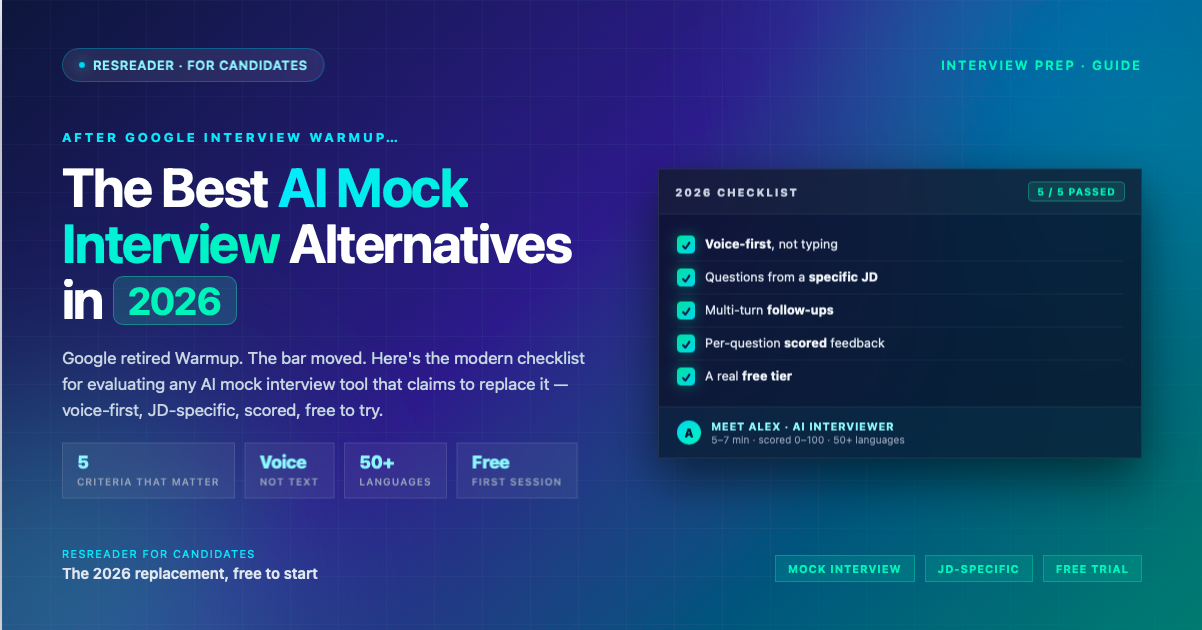
When you're evaluating any AI mock-interview tool, check whether it does these five things. Tools that miss two or more are doing 2022-era prep with 2026 marketing.
- Voice-first, not text-first. You will not type your answers in a real interview. Practicing by typing trains the wrong reflexes. A modern tool should accept voice in real time and respond by speaking back.
- Questions generated from a specific job description. Generic field-level questions are warm-ups, not training. The tool should read the actual JD you're targeting and generate questions from it. Bonus: it should reference your resume when relevant.
- Multi-turn follow-ups. When your answer is vague, a real interviewer asks "can you give me a specific example?" An AI that doesn't do this isn't simulating anything close to a real interview.
- Per-question scored feedback. An overall score is fine; per-question scores are better, because they tell you which answer to fix. Look for written strengths and improvements that quote things you actually said, not generic platitudes.
- A real free tier. Practice only works if you can iterate. A tool that gives you one preview question and then demands a credit card isn't replacing Warmup — it's a lead-gen funnel.
A sixth bonus criterion that matters if you're not interviewing in English: multilingual support. Warmup was English-only. The job description in your inbox is increasingly likely to be in Spanish, German, French, Mandarin, Turkish, or any other major language. A modern tool should run the entire session in the language the job is posted in.
ResReader for Candidates: how it scores against the criteria
We built ResReader for Candidates partly because Warmup's retirement left a real gap, and partly because the bar above is the one we wanted to clear. Here's how the tool maps to each criterion:
Voice-first. Yes. The mock interview runs over a real-time voice connection. You and an AI interviewer named Alex actually talk. About 5–7 minutes per session, five questions on the standard difficulty (configurable from three for a fast warm-up to sixteen for a longer loop).
JD-specific questions. Yes. Paste the job description before starting, optionally attach your CV. Alex generates questions from the JD's required skills and seniority, and references your CV when relevant: "Your CV mentions you led the Postgres migration at Acme — walk me through the rollout." That kind of question is impossible from a generic question bank.
Multi-turn follow-ups. Yes. If your answer is thin or off-topic, Alex follows up. The conversation rhythm is closer to a real screening call than a quiz.
Per-question scored feedback. Yes. After the session you get an overall 0–100 score, a per-question score for each of the five questions, written strengths, written improvements, and a 2–4 sentence summary. Feedback quotes things you actually said.
A real free tier. Yes. Try one mock interview for free — no credit card. Find a job posting you actually care about, drop in your CV, and Alex will interview you on it. Five minutes later you'll have a real score and a real list of things to fix. Start here: resreader.com/en/candidate.
Multilingual. Yes — if the JD is in Spanish, the interview runs in Spanish. German, French, Mandarin, Japanese, Turkish, and 45+ more. Feedback comes back in the same language.
There are real trade-offs we won't pretend away:
- Warmup needed nothing; ResReader needs a free account.
- Warmup ran in a tab with optional speech-to-text; ResReader needs microphone access. Camera is optional but recommended — the conditions are closer to a real video screen.
How to use the post-Warmup landscape well
Three principles that matter more than any specific tool choice:
Practice in the language of the job. If the JD is in German, practice in German. The cognitive load of switching languages mid-sentence under pressure is real, and the first ten minutes of a real interview is when you're most vulnerable to it. Mock-interview tools that support multilingual sessions exist specifically for this — use them.
Do two sessions per role, not one. First session is your baseline. Read the feedback. Sleep on it. Second session is where the score moves. The delta between the two sessions is the actual learning. One session tells you where you are; two tells you what to fix.
Don't practice the morning of the real interview. Twenty minutes before the call is too late to internalize new feedback, and a low score will spike your nerves about whatever the real interviewer asks. Prep two days out, polish one day out, then close the laptop.
A 2026 replacement to start with
If you used Google Interview Warmup and you've been looking for what to switch to, open ResReader for Candidates, create a free account, and head to the Mock Interview tab. Paste the next job description you're applying to, optionally upload your CV, click Start Interview. Five minutes later you'll have your first score and your first specific list of things to fix.
It's not Warmup. It's the thing Warmup would have grown into if Google had kept building it. And the first session still costs nothing.